Well, Facebook didn't reveal a new phone or operating system today -
instead the social network announced a new Graph Search. This new
feature offers a multitude of new ways to use Facebook's search function
to help you find the right people, photos and more.
What is Graph Search?
You
can still search in the usual way, but you can also ask Graph Search to
find exactly what you're looking for. Launching now is the beta (or
early) version of Graph Search, and it focuses on four areas: people,
photos, places and interests. It's only available in U.S. English for
now.
What is Graph Search?
Graph Search is a new way for you to find people, photos, places and interests that are most relevant to you on Facebook.
You'll
be able to find others even though you may not know their name, as well
as learn more about them and make connections. What's more, you can
explore photos, quickly find places like local attractions and
restaurants, and learn about friends' common interests such as music,
movies and books.
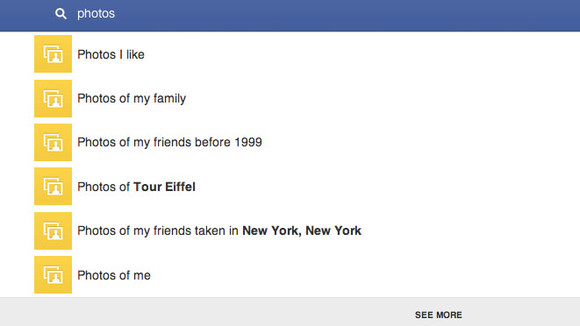
Graph Search appears as a bigger search bar at
the top of each page. As you start to type, suggestions appear in a drop
down. You can refine your search using the tools on the right-hand side
of the page.
"When you search for something, that search not only
determines the set of results you get, but also serves as a title for
the page," says Facebook director of engineering Lars Rasmussen. "You
can edit the title – and in doing so create your own custom view of the
content you and your friends have shared on Facebook."
What can you ask Graph Search?
Your Graph Search query can be
very specific. One example given at Facebook's launch event was "people
named Chris who are friends of Lars and went to Stanford" – so you
really can find someone you met once and remember by mere association.
You can also use a search example like "my friends who like Lady Gaga" or "photos of Sue taken in Bristol in 2005."
Why has Facebook launched Graph Search?
Facebook says there
are more than a billion people on the social network who have posted 240
billion photos and have more than a trillion connections. The company
believes it needs to provide "the tools to map out their relationships
with the people and things they care about." Facebook refers to this map
as "the graph."
"When Facebook first launched, the main way most
people used the site was to browse around, learn about people and make
new connections," says Rasmussen. "Graph Search takes us back to our
roots and allows people to use the graph to make new connections."
Is Graph Search taking on Google?
Graph Search and web
search are very different, explains Rasmussen. "Web search is designed
to take a set of keywords (for example: 'hip hop') and provide the best
possible results that match those keywords.
"With Graph Search
you combine phrases (for example: "my friends in New York who like
Jay-Z") to get that set of people, places, photos or other content
that's been shared on Facebook. We believe they have very different
uses."
What about Graph Search privacy?
Facebook says that
Graph Search has been built with privacy in mind, primarily because
often it's searching content that's very appropriate to you, but its
completely different from something that somebody else would see if they
did the same search.
According to Facebook, the Graph Search
"respects the privacy and audience of each piece of content on
Facebook," meaning you'll only see results you could already see
elsewhere on Facebook.
What's next for Graph Search?
The
social network says they're "very early" in the development of Graph
Search. It's only available in the U.S. today, and you can search for
only a subset of content on Facebook – people, photos, places and
interests only at the moment. Posts and some auto-generated content –
such as song plays from Spotify – can't yet be searched.
What are some example Graph Searches?
People:
"friends who live in my city"; "people from my hometown who like
hiking"; "friends of friends who have been to Yosemite National Park";
"software engineers who live in San Francisco and like skiing"; "people
who like things I like"; "people who like tennis and live nearby"
Photos:
"photos I like"; "photos of my family"; "photos of my friends before
1999"; "photos of my friends taken in New York"; "photos of the Eiffel
Tower"
Places: "restaurants in San Francisco"; "cities visited by
my family"; "Indian restaurants liked by my friends from India";
"tourist attractions in Italy visited by my friends"; "restaurants in
New York liked by chefs"; "countries my friends have visited"
Interests:
"music my friends like"; "movies liked by people who like movies I
like"; "languages my friends speak"; "strategy games played by friends
of my friends"; "movies liked by people who are film directors"; "books
read by CEOs"
Facebook’s long-rumored phone ishere, though probably not in the way most had imagined. In fact, it looks exactly like the phone you already have.
Using software, rather than hardware, the latest update of Facebook’s Messenger app now lets U.S. users place voice calls over WiFi. The rollout follows reports of Facebook testing voice call features in Canada earlier this month.
To use the feature, Facebook users must hit the “i” info icon in the corner or a conversation or contact information page. That panel has a “Free Call” button that you can use if your friend has the latest version of the iPhone app.
The company slowly has been building out the features available in chat — most notably with the 2011 Skype partnership that put video calling on the Web version of its site. When it released Facebook Messenger last fall, it became even clearer that messaging and mobile applications were priorities for the company.
Rumors of a Facebook phone have been circulating for year, despite statements from Facebook, its chief executive Mark Zuckerberg and analysts saying that making a physical phone isn’t a good idea for the network.
It does make sense for Facebook to make it easy for users to contact their online networks. But the smartphone industry is not an easy one to crack. Apart from the fact that Facebook hasn’t made hardware in the past, the telecommunications world has lots of complicated barriers to entry such as dealing with carriers and the challenge of taking on Apple’s iOS and Google’s Android mobile operating systems. Facebook also could go the partnership route, but it’s already done that with the not-so-successful HTC Status.
Consumers are increasingly looking for companies and devices that give them a rich, complete experience rather than those that do a single thing. Take, for instance, the iPod, which has had to become a still and video camera in addition to playing music to hang on in a post-iPhone era.
By going the software route, Facebook can step neatly around those issues. And it’s not alone, as was clear from the growing software and content focus at this year’s International Consumer Electronics Show. Much of the tech industry is using this same approach — software, not hardware — to test the appeal of features without getting entrenched in building, marketing and drawing users to their gadgets..!

The tech press started buzzing earlier this month with reports that Facebook planned to add VoIP (voice over IP) calling to its Messenger app for the iPhone. The new feature officially arrived Tuesday, when Facebook released an update for its app.
Facebook's app transmits calls using your phone's broadband connection, whatever it is -- 3G, 4G or Wi-Fi. Instead of sucking up your monthly allotted voice minutes from your cellular carrier, it sucks up megabytes from your data plan. That's a boon for heavy talkers with unlimited data plans.
This is nothing new or technologically groundbreaking: Skype was doing it long before Facebook. Facebook has many more active users than Skype, though, and the allure of having to use one less network or app will appeal to some (perhaps many).
But it's not all roses just yet. For now, this is a pretty limited offering.
Your phone won't alert you the way it does when you have a normal call: Facebook calls just show up as a push notification. And right now, you can only connect with a conversation partner who also has Messenger installed on their iPhone.
There's no way to ring up a Facebook friend who is logged in through the website, and there isn't any way to place a call to a ten-digit phone number. Calling is still absent from the Android and BlackBerry versions of the Messenger app.
There's a good reason for those omissions. The VoIP features in the Web version of Facebook were built using Skype's technologies, while the calling technology in Messenger is all Facebook. The ability to place and receive calls using traditional phone numbers requires telecommunications resources Facebook doesn't have (at the moment, at least).
For the time being, services such as Google (GOOG, Fortune 500) Voice and Skype have a leg up, given their larger feature sets. But Facebook generally doesn't let anything remain in stasis for long. As we've seen in the past -- and caught a glimpse of yesterday with the Graph Search reveal -- Facebook likes to start small, and steadily flesh out its products. Expect the same with voice calling.
And unlike Google Voice and Skype (which is owned by Microsoft (MSFT, Fortune 500)), Facebook is 100% platform neutral. Facebook (FB) doesn't care if you use its app on an iPhone, Android, Windows Phone, BlackBerry or something crazy like Ubuntu.
In a time when every company is saving the best features of its products for its own mobile ecosystem, Facebook has the opportunity to both usurp its direct competition and build out a telecom-slaying voice service.
 T he desktop on your Linux box used to stand for something very simple. If you were a KDE user, you valued control, power and the ability ...
 E ver since Nikon put a 24-million effective pixel sensor in the D3200 we've been expecting this pixel count to reach a little furth...
 J ust how bad do you have to be to get banned from Gmail? How many policies and terms do you have to violate to warrant suspension, or wor...
 W indows 8 users running Skype will now have the option to exert greater control over who can contact them, thanks to a new software updat...
 M cAfee AntiVirus (AV) Plus 2013 is a sub-$50 home security suite featuring a redesigned user interface (UI), along with extra security too...