M cAfee AntiVirus (AV) Plus 2013 is a sub-$50 home security suite featuring a redesigned user interface (UI), along with extra security too...
Of all Facebook’s data sets, it’s the social graph that’s truly unique. It’s spent nine years getting you to confirm who you know, and apparently it’s sick of handing over your friend list to competitors. This week it cut off both Twitter’s new photo app Vine and messaging app Voxer from Find Friends, Facebook’s API that lets you connect with Facebook friends on other apps. But this could backfire.
Facebook knows who you are, what you’re interested in, where you go on the web, what apps you use, and more. However, other companies have bits and pieces of these data sets. LinkedIn knows your resume, Google knows your web searches, Twitter knows who you follow, Apple and Amazon have your credit card number, and your phone’s OS-maker knows what apps you’ve downloaded. Who your real-life friends are, though, is Facebook’s domain. Facebook Social Graph
Reconfirming your social graph manually on other apps is awkward at worst and annoying at best. Think about it. If your Facebook account was reset and you had to send friend requests to all your old friends, how many do you think would confirm? Even your best friends might be too lazy to, and people who were glad to friend you when you met years ago probably wouldn’t bother if they remember you.
There’s plenty of noise in the Facebook’s social graph. Some people blindly accept most requests they get, others send them to anyone they meet once, and all the connections grow stale over the years. Still, if you want to jumpstart a social app, Facebook’s Find Friends feature is very valuable. It can be the difference between an empty feed and low retention, and a vibrant, addictive feed teeming with content from people you care about. Find Friends ScreenshotFacebook has offered Find Friends for years. But those were years when it was a web-based social network. It’s more now, or at least it wants to be. Facebook hopes to host all the ways you communicate. That has pitted it against Apple, Google, and other companies in war for messaging that’s only just heating up.
Data portability first became a big issue in 2010 when Facebook blocked Twitter from using its Find Friends feature. Later that year it got into a spat with Google about exporting contact lists. Google was pissed Facebook was sucking in Gmail contacts but not exporting friend lists. Facebook eventually began offering Download Your Data, which included your Friend List, but only in plain text.
More recently though, Twitter may have awoken the dragon when it cut off Instagram’s access to Twitter’s own version of “Find Friends”. It was an understandable retaliation since Facebook had cut it off, and Twitter had wanted to buy Instagram too.
Now Facebook is coming out swinging, citing its Platform Policy that states “Competing social networks: (a) You may not use Facebook Platform to export user data into a competing social network without our permission.”
Last week it blocked voice messaging app Voxer’s access to the social graph. At the time, Facebook told me this was because Voxer qualified as a competing messaging, but also because Voxer wasn’t contributing much back to Facebook. Voxer only had a buried, and largely unnecessary ”share to Facebook” option. It got an email stating its Find Friends access would be revoked 48 hours later.
Then today Facebook shut off Find Friends for Twitter’s Vine, as spotted by Jeff Martines and reported by The Verge. That makes both more and less sense. More because Twitter is a real competitor. It has decent scale and mindshare, and competes for the same advertisers as Facebook. Twitter would love to know your Facebook social graph, which could help it refine its version, the “interest graph”, which powers its ad targeting.Vine Blocked.
It makes less sense because Vine had a prominent “share to Facebook” option. What happened to Facebook only going after apps that don’t contribute much back? Apparently that got overruled because Twitter is a more legitimate threat. So much so that Facebook employed its policy that “we reserve the right to take action against your app even before the end of this 48 hour period.” It didn’t want Twitter getting any social graph data.
Enforcement of these policies could create a moat around Facebook. It creates a barrier to engagement, retention, and growth for competing companies. It will force social apps to rely on other data sets, such as your phone’s contacts which may not have as complete of a social graph, though likely does include your closest friends whose numbers you have.
That advantage may not be worth it, though. The enforcement means Facebook is not an “open platform”. If companies are worried that Find Friends or other Facebook data access could be ripped away from them with little notice, it could cause a chilling effect on development on the Facebook platform. No one wants to build an app that relies on Facebook data if it could disappear.
Facebook reaffirmed this fear this morning when it enforced its ban on exporting data for use in social networks. Russian search engine Yandex’s new social search mobile app Wonder got all of its API calls blocked just three hours after launch. That’s a lot of programming and product work down the drain.
Facebook is playing with fire. It could use policy enforcement to cook competitors and shine a light on its dominance of social networking. But if this enforcement scares off developers whose apps might otherwise provide content for that could be shown next to ads in the news feed and piped into Graph Search, Facebook could get burned badly.
Via techcrunch (Thanks)
We're seeing numerous reports that Facebook has begun enabling Graph Search for users that were among the first to sign up for the beta program last week. The ambitious new feature promises to change the way you find things on the social network by returning results to natural language queries like "restaurants nearby my friends like" and "pictures of my friends and me." Once you accept Facebook's invitation to try Graph Search, the menubar at the top of the site will switch to a new design that places universal search on the left and relocates friend requests, messages, and notifications over to the ride side of the screen. If you're lucky enough to be among the early participants, feel free to discuss your thoughts on the new Facebook below. And for those that haven't gotten around to it yet, it's not too late to join the Graph Search waiting list.
Facebook has admitted that it has 'no effective mechanism in place' to prevent children under the age of 13 from setting up profiles.
The social network decrees that users have to be at least 13 to join the site, but the lack of an effective age verification system makes it easy for pre-teens to sign up for an account.
Despite Facebook's efforts, research from a professor at the London School of Economics estimates that a massive 34 per cent of UK 9-12 year olds now have a Facebook page.
Facebook's director of policy for Facebook UK and Ireland, Simon Milner called the problem "tricky" but admitted there is no system in place to prevent young children lying about their age.
Facebook isn't unsafe?
Speaking at an Oxford Media Convention, he said: "We haven't got a mechanism for eradicating the problem."
Surprisingly, Milner also hinted that if not for a US privacy law, the age restrictions may not be in place, because the company does not feel that Facebook is unsafe for young children.
He added: "Facebook does have a rule that users have to be over 13, as does YouTube, which not a lot of people know.
"It is not because we think that Facebook is unsafe but because of a US law about children's online privacy. So we have it as a global rule."
Young kids listen, teens don't
Sonia Livingstone, the LSoE professor who conducted the research, reckons the number of underage users is only going to get higher as social media continues to flourish.
She said: "I would assume that figure is going up and would assume younger children are also having profiles.
"If parents would only say to young children, 'don't go on Facebook', we have found that they listen. Teenagers don't, but younger children do."
Despite claiming that Facebook isn't unsafe for pre-teen users (and those above 13 for that matter), Milner insisted that it has tough policies to eliminate bullying, grooming, pornography and nudity.
Via Guardian (Thanks)
RIM's yet-to-be-announced BlackBerry Z10 handset has come face-to-face with the iPhone 5 in a new comparison video.
The all-touchscreen BB10, which is all set for a grand unveiling at the end of January, has been leaked more times than we care to remember, but never in this much deal and never next to its chief nemesis.
German blog telekon-presse.ak has provided a hands-on with what is all-but-certain to be the Z10, comparing design, build, software and features with Apple's latest and greatest mobile handset.
According to the hands-on comparison, the BB10 voice control system does a better job than Siri during a request to send a message. It was more accurate and faster on the Z10 than the iPhone 5.
What's left to see?
The video also shows how the respective operating system deals with incoming text messages and offers a neat look at BB10's Peak View feature, which gives users a quick look at items in the BlackBerry Hub.
Other highlights include a look at the different ways multitasking is handled by the OS, and how app icons are presented while it also shows how to kill active apps and offers a look at the respective Twitter apps.
You can check out the interesting video comparison below. At this rate RIM will have nothing left to reveal on January 30, when it holds launch events around the world.
What do you think? On that evidence can the Z10 challenge the iPhone 5 on a level playing field? Let us know in the comments section below.
Via TechCrunch (Thank You)
Well, Facebook didn't reveal a new phone or operating system today -
instead the social network announced a new Graph Search. This new
feature offers a multitude of new ways to use Facebook's search function
to help you find the right people, photos and more.
What is Graph Search?
You
can still search in the usual way, but you can also ask Graph Search to
find exactly what you're looking for. Launching now is the beta (or
early) version of Graph Search, and it focuses on four areas: people,
photos, places and interests. It's only available in U.S. English for
now.
What is Graph Search?
Graph Search is a new way for you to find people, photos, places and interests that are most relevant to you on Facebook.
You'll
be able to find others even though you may not know their name, as well
as learn more about them and make connections. What's more, you can
explore photos, quickly find places like local attractions and
restaurants, and learn about friends' common interests such as music,
movies and books.
Graph Search appears as a bigger search bar at
the top of each page. As you start to type, suggestions appear in a drop
down. You can refine your search using the tools on the right-hand side
of the page.
"When you search for something, that search not only
determines the set of results you get, but also serves as a title for
the page," says Facebook director of engineering Lars Rasmussen. "You
can edit the title – and in doing so create your own custom view of the
content you and your friends have shared on Facebook."
What can you ask Graph Search?
Your Graph Search query can be
very specific. One example given at Facebook's launch event was "people
named Chris who are friends of Lars and went to Stanford" – so you
really can find someone you met once and remember by mere association.
You can also use a search example like "my friends who like Lady Gaga" or "photos of Sue taken in Bristol in 2005."
Why has Facebook launched Graph Search?
Facebook says there
are more than a billion people on the social network who have posted 240
billion photos and have more than a trillion connections. The company
believes it needs to provide "the tools to map out their relationships
with the people and things they care about." Facebook refers to this map
as "the graph."
"When Facebook first launched, the main way most
people used the site was to browse around, learn about people and make
new connections," says Rasmussen. "Graph Search takes us back to our
roots and allows people to use the graph to make new connections."
Is Graph Search taking on Google?
Graph Search and web
search are very different, explains Rasmussen. "Web search is designed
to take a set of keywords (for example: 'hip hop') and provide the best
possible results that match those keywords.
"With Graph Search
you combine phrases (for example: "my friends in New York who like
Jay-Z") to get that set of people, places, photos or other content
that's been shared on Facebook. We believe they have very different
uses."
What about Graph Search privacy?
Facebook says that
Graph Search has been built with privacy in mind, primarily because
often it's searching content that's very appropriate to you, but its
completely different from something that somebody else would see if they
did the same search.
According to Facebook, the Graph Search
"respects the privacy and audience of each piece of content on
Facebook," meaning you'll only see results you could already see
elsewhere on Facebook.
What's next for Graph Search?
The
social network says they're "very early" in the development of Graph
Search. It's only available in the U.S. today, and you can search for
only a subset of content on Facebook – people, photos, places and
interests only at the moment. Posts and some auto-generated content –
such as song plays from Spotify – can't yet be searched.
What are some example Graph Searches?
People:
"friends who live in my city"; "people from my hometown who like
hiking"; "friends of friends who have been to Yosemite National Park";
"software engineers who live in San Francisco and like skiing"; "people
who like things I like"; "people who like tennis and live nearby"
Photos:
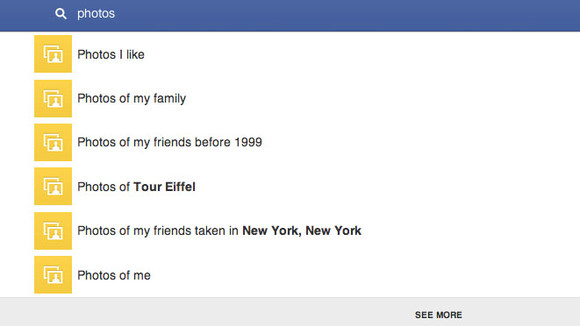
"photos I like"; "photos of my family"; "photos of my friends before
1999"; "photos of my friends taken in New York"; "photos of the Eiffel
Tower"
Places: "restaurants in San Francisco"; "cities visited by
my family"; "Indian restaurants liked by my friends from India";
"tourist attractions in Italy visited by my friends"; "restaurants in
New York liked by chefs"; "countries my friends have visited"
Interests:
"music my friends like"; "movies liked by people who like movies I
like"; "languages my friends speak"; "strategy games played by friends
of my friends"; "movies liked by people who are film directors"; "books
read by CEOs"
Facebook’s long-rumored phone ishere, though probably not in the way most had imagined. In fact, it looks exactly like the phone you already have.
Using software, rather than hardware, the latest update of Facebook’s Messenger app now lets U.S. users place voice calls over WiFi. The rollout follows reports of Facebook testing voice call features in Canada earlier this month.
To use the feature, Facebook users must hit the “i” info icon in the corner or a conversation or contact information page. That panel has a “Free Call” button that you can use if your friend has the latest version of the iPhone app.
The company slowly has been building out the features available in chat — most notably with the 2011 Skype partnership that put video calling on the Web version of its site. When it released Facebook Messenger last fall, it became even clearer that messaging and mobile applications were priorities for the company.
Rumors of a Facebook phone have been circulating for year, despite statements from Facebook, its chief executive Mark Zuckerberg and analysts saying that making a physical phone isn’t a good idea for the network.
It does make sense for Facebook to make it easy for users to contact their online networks. But the smartphone industry is not an easy one to crack. Apart from the fact that Facebook hasn’t made hardware in the past, the telecommunications world has lots of complicated barriers to entry such as dealing with carriers and the challenge of taking on Apple’s iOS and Google’s Android mobile operating systems. Facebook also could go the partnership route, but it’s already done that with the not-so-successful HTC Status.
Consumers are increasingly looking for companies and devices that give them a rich, complete experience rather than those that do a single thing. Take, for instance, the iPod, which has had to become a still and video camera in addition to playing music to hang on in a post-iPhone era.
By going the software route, Facebook can step neatly around those issues. And it’s not alone, as was clear from the growing software and content focus at this year’s International Consumer Electronics Show. Much of the tech industry is using this same approach — software, not hardware — to test the appeal of features without getting entrenched in building, marketing and drawing users to their gadgets..!
Today in international tech news: Google denies that a Street View
expedition killed a donkey, despite its own images that appear
incriminating. Also, a one-man outsourcing scheme is busted, the EC
might force companies that lose data to report it publicly and
Australian authorities investigate the nation's online fake ID market.
Google seems to have had a dustup with a donkey -- literally.
Images plucked from Google Street View have raised questions about whether a Google Street View car ran over a donkey in the African nation of Botswana.
Images culled from Street View show a donkey lying in the road. One of the images also shows dust hovering over the donkey, possibly suggestive of a recent tumble.
News.com.au reports that "the company allege that the Google Street View car approached the donkey which was already lying down," at which point the donkey got up and walked away. However, based on the images it received from Google the donkey then have had to walk backwards, news.com.au said.
Google denies that the donkey was injured.
One-Man Outsourcing Scheme Busted
A software developer for Verizon has been busted for paying someone in China to log in to his work computer and do his work for him, according to PCMag.com.
As the story goes, the man physically shipped his RSA token, a security authentication mechanism, to China, where a contractor used it to log in under the man's credentials during U.S. working hours.
The worker's scheme was reported in a since-removed (but cached) blog post by J. Andrew Valentine, who was part of a forensic and investigative response team within Verizon. The employee in question was not named, but was described in the post as a programmer who was "inoffensive and quiet."
Valentine's post says that the man, who made six figures with Verizon, is thought to have had "the same scam going across multiple companies," according to Valentine's post.
EC Considering Mandatory Data Reports
The European Commission is considering a plan that would force companies that store data on the Web to disclose the loss or theft of personal information, according to The New York Times.
Details of the plan, which would affect companies such as Google, Apple, IBM and Microsoft, are expected to be presented Friday. The proposal, which would supplant the EU's current array of national laws, would impose the first-ever "EU-wide reporting requirements" for companies operating large databases used for Internet searches, social networks, cloud services and e-commerce, according to The Times.
The plan is designed to thwart cybercrime, which is a growing problem in the EU. Numerous "high-profile attacks" have hit businesses and governments, including 821 in Britain in 2011 alone.
Aussie Police Investigate Fake ID Sites
I wish it were this easy to get fake IDs when I was in high school.
Australian police and government authorities are investigation Web-based "fake ID stores," according to Australian outlet The Age.
The IDs are reportedly used to buy booze and get into bars and clubs (duh).
One popular site, fakies.com.au, has promoted itself on Facebook to the tune of nearly 12,000 "likes." The IDs cost about US$60 a pop. The company's notice that its products are "strictly for novelty use" is likely lost on buyers.
Surprise Phone Bills Irk Brits
A spike in consumer complaints to British regulator PhonepayPlus suggests that enormous -- and unexpected -- phone bills are becoming more of a problem for the UK.
PhoneplayPlus reported a 300 percent surge in complaints, according to the BBC. The main culprits, according to the regulator, are apps that are downloaded for free but that then start pestering users to buy things, as well as apps that contain malware and trick people into running up bills.
The tech press started buzzing earlier this month with reports that Facebook planned to add VoIP (voice over IP) calling to its Messenger app for the iPhone. The new feature officially arrived Tuesday, when Facebook released an update for its app.
Facebook's app transmits calls using your phone's broadband connection, whatever it is -- 3G, 4G or Wi-Fi. Instead of sucking up your monthly allotted voice minutes from your cellular carrier, it sucks up megabytes from your data plan. That's a boon for heavy talkers with unlimited data plans.
This is nothing new or technologically groundbreaking: Skype was doing it long before Facebook. Facebook has many more active users than Skype, though, and the allure of having to use one less network or app will appeal to some (perhaps many).
But it's not all roses just yet. For now, this is a pretty limited offering.
Your phone won't alert you the way it does when you have a normal call: Facebook calls just show up as a push notification. And right now, you can only connect with a conversation partner who also has Messenger installed on their iPhone.
There's no way to ring up a Facebook friend who is logged in through the website, and there isn't any way to place a call to a ten-digit phone number. Calling is still absent from the Android and BlackBerry versions of the Messenger app.
There's a good reason for those omissions. The VoIP features in the Web version of Facebook were built using Skype's technologies, while the calling technology in Messenger is all Facebook. The ability to place and receive calls using traditional phone numbers requires telecommunications resources Facebook doesn't have (at the moment, at least).
For the time being, services such as Google (GOOG, Fortune 500) Voice and Skype have a leg up, given their larger feature sets. But Facebook generally doesn't let anything remain in stasis for long. As we've seen in the past -- and caught a glimpse of yesterday with the Graph Search reveal -- Facebook likes to start small, and steadily flesh out its products. Expect the same with voice calling.
And unlike Google Voice and Skype (which is owned by Microsoft (MSFT, Fortune 500)), Facebook is 100% platform neutral. Facebook (FB) doesn't care if you use its app on an iPhone, Android, Windows Phone, BlackBerry or something crazy like Ubuntu.
In a time when every company is saving the best features of its products for its own mobile ecosystem, Facebook has the opportunity to both usurp its direct competition and build out a telecom-slaying voice service.
Facebook’s new Graph Search feature suddenly makes the search bar at the
top of its pages — which you were probably ignoring — a lot more
interesting.
The updated search function, announced Tuesday, lets users dig through most of the the Facebook data that’s visible to them on the site to answer some simple questions. The company is rolling the feature out slowly, so it’s in a limited beta at the moment. But here are some practical ways in which you can or will be able to use Facebook’s Social Graph:
Look for a bite to eat: The graph allows users to look for places, photos, interests and people. But beyond simply searching for area restaurants that your friends “like,” you can tailor your search to restaurants that have gotten a nod from friends who have also posted on Facebook that they lived in a certain country, like Thai food or are vegetarians.
Help with a career search: Your Facebook network may be bigger than you think, given how much gets shared with friends of friends, and Graph Search lets you sift through all of that data. So, if you’re looking for a job in a particular field or city, you could search for “friends of friends who are lawyers” to find some contacts. You could also look for a particular company name to find a contact there. But etiquette dictates that you ask your mutual friend for permission before sending his or her friend a Facebook message.
Find a date: Company chief executive Mark Zuckerberg highlighted this option in Tuesdays press conference, according to a report from VentureBeat. Since Facebook allows users to post whether they’re married, single, in a relationship or romantically “complicated” entanglements, you could run a query for “friends of friends who are single and like mountain biking.” Voilà -- instant date prospect. This could also prove to be an invaluable tool for busybody matchmakers.
Take a nostalgic look back: Heading down memory lane? Photo searches can reveal pictures of your alma mater within a certain time period. Or you can look for photos that folks have posted of themselves as kids by typing in a search for pictures taken before a certain year. As with other queries, you can stack terms in photo searches, so you could also look for photos of a certain place at a certain time. If you’re ready to go back to the future, you can also get ideas for where to go on your next trip by perusing other people’s vacation snaps.
Find a good read: You can look up books your friends like, or be more specific in your query: “books my friends who like War and Peace like.” You can also use this tool to find books that people in certain professions or areas of the country are reading.
Organize a pickup game: If you’re feeling restless, why not search for friends nearby who like the same sport you do — soccer, basketball, ultimate frisbee, whatever — and organize a quick pickup game. The same goes for users seeking running buddies, biking companions or — why not? — chess partners or fans of the same co-op video game.
Finally, if some of these applications seem a little invasive, you can take measures to limit what data of yours go into social graph search. That could involve spending quite a bit of quality time with the network’s privacy tools.
All the things mentioned above are examples of data that you may be sharing with friends of friends or the public. On Facebook, every post comes with its own privacy drop-down menu, so you can adjust your posts and likes whenever you want to restrict it to certain friends or groups. Only those friends will see that information pop up in any of their own searches.
Facebook users can change settings on their bio and geographical information by editing their “About” section. There’s also has a new drop-down menu at the top of most pages that lets you set future default privacy settings for future posts.!
Facebook’s 1 billion users will soon be able to search their friends’ favorite vacation spots or most-traveled running trails using a new tool unveiled by the company Tuesday.
Graph Search marks Facebook’s entry into the search market currently dominated by Google and could allow the social network to leverage the treasure trove of information it keeps on the “likes,” interests and preferences of its users with advertisers.
“Graph Search lets you tap into the value of that information,” said Kate O’Neill, a Facebook product marketing manager.
Facebook said that users will be able to look up such information as “friends who live in my city,” “photos I like” or “Indian restaurants liked by my friends in India” and get the results instantly. Microsoft, which holds a small stake in Facebook, will serve up answers from the Bing search engine when Facebook can’t.
“The social link gives you additional context,” said Andrew Tonner, an analyst with the Motley Fool. “You’re more likely to take some sort of action if someone you know has also had a favorable experience.”
Facebook chief executive Mark Zuckerberg announced the effort with much fanfare at the company’s California headquarters. Investors have been nervous about Facebook’s ability to sustain revenue since its public offering last year and appeared unimpressed by the company’s announcement. Facebook shares, which soared ahead of the announcement, fell nearly 3 percent on the news, closing at $30.10 per share.
The test version will not come with enhanced advertising and is not available on mobile devices, which make up an growing share of Facebook’s traffic.
If the tool is successful, Facebook could become competitive with Google, which has more than 60 percent of the search market and has made a similar attempt to marry search and social data. Although the two companies have similar products, said Ovum technology analyst Jan Dawson, they’re currently serving different audiences.
“Facebook is never going to answer your homework questions,” he said.
Making the network’s data easier to search could raise privacy concerns. Facebook noted that search results will display only data already visible to a particular user.
That mitigates some of the concerns, as does Facebook’s recent push to have users review privacy settings on their older posts, said Justin Brookman, director of consumer privacy at the Center for Democracy and Technology.
The fact that users will have to seek out the information rather than having it automatically displayed also makes a big difference, he said. “It’s not a push — it’s a pull,” he said.
Mark Zuckerberg demonstrated a search service that taps into the information shared by a Facebook user’s friends.
Here are the takeaways from today’s announcement:
Facebook’s Graph Search will
provide a way to sort through all the information shared by those in
your social network using natural language queries.
Based on company demos, Graph Search looks like a promising way to
find products or services you might like, and to identify local
businesses you might want to visit.
Facebook has partnered with Microsoft’s Bing to deliver results from the Web when Graph Search can’t find something.
Zuckerberg says he’d love to work with Google but Microsoft is more willing to work on its terms.
The service will be rolled out to a few hundred thousand people initially.
Facebook plans to broaden it to non-English languages and to other platforms such as mobile, but did not provide a timeline.
2:14 PM With
that we’re done with the formal presentation, and I’m off to check out
Graph Search at the demo stations! Thanks for reading!
2:13 PM: Sixteenth question: how will businesses be able to use Graph Search?
Tom says most business page owners focus on distribution through News
Feed. This is a new context where their information can exist. So it’s
more important to make sure the info on your business page is up to
date. Your tag is the right type for your restaurant, etc.
Seventeenth question: will Instagram data be in there?
Mark says “That should be on the list of things we will hopefully one
day get to.” He reiterates that this is a beta product and they know
they didn’t get to everything. That’s because it’s really hard and takes
years and years.
2:10 PM Fourteenth question: have you tested this with people outside of Facebook?
Tom says they bring users in and let them try it out, and that’s what
led to a lot of the changes they made over time. Mark says user tests
were “very positive”. They didn’t
want to come up with a specific grammar people had to learn. You can
just type things like “friends New York” to get friends who live in New
York. Someone notes that it doesn’t have to be as structured as the way
they phrased things during the demos.
Fifteenth question: in sorting places, are you relying on “likes”?
Lars says when you see a set of results in Graph Search it’s sorted
by a number of features–who has liked, checked in to a place, etc. all
the info they have about a thing is fed into their ranking algorithm.
2:00 PM Eighth question: was there any consideration of working with Google?
Mark says, “I would love to work with google. When we did our Bing
Web search integration we were very public about the fact that this
wasn’t a thing we were trying to do with Bing–we want to make search
social in general.”
Ninth question: Why even have Bing in there if people aren’t coming to Facebook to do Web searches?
Mark says there is a lot of content you can find with Graph Search,
but a lot you can’t find with it, too. It’s better to show good Web
results than nothing when people ask certain things, he says.
Tenth question: search is very resource-intensive–what did you have to do to get this all together?
Lars says building out the software for this took more than a year, lots of engineering work.
Eleventh question: any plans to couple voice search with Graph Search?
Mark says not right now.
Twelfth question: What do you want Google to do that they’re refusing to do?
Mark is smiling and not sure what to say. He
says when people share something on Facebook they want to give them the
ability to change things later–take things down quickly, for example.
Google has a system that works really well for them about how they treat
information, but he thinks Facebook is different. Hmm, okay.
Thirteenth question: you’re talking about creating a great user
experience, and that might be when you see restaurants your friends like
to show more info–prices, menus, etc–any plans to add this stuff?
Mark says they have lots of teams at Facebook. They spend most of
their time on helping people share content with other people. As that
info comes online in the coming years, they definitely want to add it to
Graph Search, he says.
1:55 PM Ah, now they’re doing Q&A with Tom, Lars, and Mark.
First question: how will you make sure people understand the difference between hiding from the timeline and hiding from search?
Tom says that at the end of last year they sent a message to users
encouraging them to take a look at their settings, and rolled out easier
privacy controls. And it’s also about pointing out the differences
between hiding things from timeline and from graph search.
Second question: can this be built into products, apps, etc?
Mark says they would love to. “This is really a beta of a V1,” he
says, and there are years of work ahead. Eventually he thinks it will be
useful for developer apps, so that sounds like that coming.
Third question: where do you see advertising, sponsored placement fitting in?
Mark says this could be a business opportunity for them over time,
but for now they want to make it something that is high-quality that
does what users want. They have had sponsored search results for a
while, he reminds us.
Fourth question: how soon will this be available to how many people, and how soon on mobile?
Mark says it’s going to be available to a “very small audience”
today–hundreds or thousands of people. They don’t know what people will
search for, so it’s hard for them to estimate rollout. Mobile is the
next thing they want to take on, but no “concrete estimates” for how
long.
Fifth question: how will what I search for influence the ads I see? And who else can see my searches?
Lars says nobody else can see what you search for.
Sixth question: how do you know this is what people want from Facebook?
Mark says they try to understand what people are trying to get out of
Facebook and synthesize that into products and services anyone can use.
People have been asking for a long time about place search, he says.
“We’re pretty confident from the feedback we’ve gotten that this will be
useful for a lot of folks,” he said.
Seventh question: did Microsoft have any involvement in Graph Search?
Lars reminds us that if Facebook can’t answer your question very well
with graph search, it will show you results from Bing. They worked
closely with the Bing team to make this happen, he says.
Mark says they have “great partnership” with Microsoft and that what
they do highlights the differences between Graph Search and Web search.
1:53 PM Mark
says that there are other Graph Search things they want to get
to–mobile, for example, and other languages beyond English. They also
want to index all posts and content on Facebook
Eventually they want to get to Open Graph, too, meaning all the other
content fed into Facebook. “It’s really an honor to be able to build
this service and offer it to the world,’ he says. The service will be in limited beta starting today at facebook.com/graphsearch. They’re slowly rolling it out, he says
Oh, now we’re going to watch a quick video about graph search. Lights
down! Thoughtful music swelling! The video is showing people doing
various searches and results a commercial for graph search. “photos of
my friends” for an ex; “photos before 1995”, that sort of thing. These people look like they’re having lots of fun. The end. Clapping, not me, but others. I feel no need to clap the ad.
“Graph Search is the kind of product we love to build at Facebook.
It’s a big technology problem, and it’s also a big social problem,”
Zuckerberg says. “This is who we are–we love building things like this,”
he says.
1:49 PM Mark
is back on the mic. He says Facebook built a few tools to demonstrate
all the things people will be able to see with Graph Search. He says the
company wants to get these tools in front of people before everyone in
the world gets access to Graph Search.
So there will be an “encouragement” on everyone’s home screen that
lets them see what will be happening. And you can click things you don’t
want showing up in search.
Another thing: when you can’t find what you’re looking for, Facebook
will show some search results from the wider Web through a partnership
with Microsoft’s Bing. It’s Bing-powered web search on Facebook. Uh-oh,
Google.
So if you’re searching for an artist’s new album or the weather in
Menlo Park, this would show you results drawn from Bing but on
Facebook. Mark doesn’t expect people
will come to Facebook to do general Search queries, but he thinks it’s
useful for Facebook to have it.
1:44 PM Tom is
telling us one last thing: they realize people will care about what
shows up about them in search, and they have some “great tools” to help
with that. Is Facebook a little touchy about privacy, perhaps?
The existing privacy shortcuts are available on the upper right side
of screen if you click the little lock icon, Tom says. You can see your
activity log in there–things you’ve liked/posted/commented on/etc. And
on the left are filters. You can click on one–say the photos one–and see
the set of photos that has been uploaded and tagged with you in them.
You can see which ones are publicly shared, shared with friends of
friends, hidden from timeline, etc. You
can then send a note to the owner of those photos (assuming they’re not
yours) asking them to take them down if you hate them–rather than just
untagging yourself from embarrassing photos.
1:38PM Okay, Lars
is back on the scene to show us Graph Searches involving places. He
also wants to remind us you can still search for friends by name, pages,
groups, apps, all by name. He
talks about how he had a toothache and needed a dentist, so he typed in
“dentists liked by my friends”. The second result, of course, was Mark
Zuckerberg’s dad, who is a dentist. But he chose a closer one (Zuck’s
dad is on the East Coast, of course).
He then searches for “restaurants in San Francisco, California”. Lots
of restaurants show up–they show what his friends like, what’s popular.
To get more specific he types “restaurants in San Francisco, California
liked by my friends from India” and it shows him some Indian, Thai, and
Mexican places.
This could be very useful–I often want to know what kinds of
restaurants and shops my friends dig. And this should be making Yelp
very nervous.
Then he searches for “restaurants in San Francisco, California liked
by culinary institute of America graduates”. Veerrrry clever, Lars! It
gives a list of a lot of expensive restaurants in SF, but also some
not-so-pricy ones.
1:33 PM Now Tom
is back, showing us a search for “movies my friends like”, and that will
show you a list of movies your friends like, as well as movies people
who liked those movies liked.
This could make it easier for me to figure out what to watch–an
endless struggle with Netflix. There’s also an option to see video clips
of TV shows that your friends like. “Videos by TV shows liked by my
friends” is the search for this. Now he’s searching for “TV shows liked
by software engineers”.
Heh, “Big Bang Theory” is top of the list. But they also like “Game of Thrones” and “Friends”… hmm. Next query: “TV
shows liked by doctors”. Ha, it turns out doctors like Grey’s Anatomy
and House–those are the first and second ones on the list.
Wow, here’s an interesting query “music liked by people who like Mitt Romney”. This shows Johnny Cash, Pink Floyd, Metallica. “Music liked by people who like Barack Obama” shows Michael Jackson and Lady Gaga.
You can also search for “languages my friends speak”. And you can see
just the friends who speak a particular language–useful if you need
something translated, perhaps.
1:28 PM Another
example: recruiting. Let’s say you want to recruit people from NASA—and
who doesn’t? Stocky searches “NASA Ames Research Center employees who
are friends of Facebook employees”, and a list of these people is the
result. Aand you can see who the Facebook employees are that are friends
with these NASA people. Very neat.
Another search: “People who have been product managers and who have
been founders”. Now he’s seeing all the people he can access who have
this information in their Facebook profiles.
Lars is taking the reins to show us how you can use Graph Search to
find photos. Finding the best photos of your friends? Easy, he says.
“Photos of my friends” is the search. Graph
Search picks out the best photos based on likes, comments, he says.
“For graph search, this is a walk in the park. It’s one of the simplest
things it does, but i don’t think it’s been available before,” he says. A
search for “photos of my friends taken in Paris, France”, “photos of my
friends taken in national parks”. These yield all sorts of fun outdoors
photos. Whoa, a llama! At Machu Picchu. Very cute. Lars, by the way, is wearing a sweet red t-shirt that says “hackathon” on it. Another neat example of image
search: “Photos of Berlin, Germany in 1989” (the year the Berlin Wall
came down). It turns out plenty of people have shared some cool photos
of this. You can hover over
the photos and see who shared them and with what audience–these are a
bunch of publicly-shared photos. It s a very neat way to see history.
They stress that in Graph Search you can only see content you could
already see before. This is just making it way easier to find that
content.
You can also search for “photos i like” to see all the photos you like in one place. That’s actually very cool.
1:25 PM You
really have to see Graph Search for yourself to get a feel for it, Zuck
says. So Tom Stocky and Lars Rasmussen, who worked on it, are invited
up to show it off live. Now we’re going to walk through different search scenarios…
Ruh-roh, a tiny technical glitch here with the background screens. Ah, ok - back to normal.
So there’s a search box at the top, and a number of suggestions come
down below it that suggest things to search for. Someone types “friends
who like star wars and harry potter” and gets back a set of friends, in
this guy’s case 16 of them.
Basically you’re typing in the view of how you want to see Facebook
content, and the content fills in. These results are entirely unique to
you, they say–if anyone else does this same search they’d get different
results, because they’re ordered by how close you are to people.
Another case: you meet someone in real life and want to friend them
on Facebook. So if you meet someone at a party named Chris who is a
friend of Lars, who went to Stanford, you can search for this. Stocky
does this and gets one person–Chris Cox–and can reasonably determine
this is the right person.
Another thing we can do with graph search is find dates! Alright.
Let’s say you want to set someone up with somebody else. So he searches
for “my friends of friends who are single men” and makes it specific to
San Francisco and that the woman in question should be from India,
because the person looking for a date is an Indian woman,
hypothetically.
1:18PM What they came up with looks like a real-time
search. You can type “photos of my friends in Arizona” or whatnot, and
it will try to come up with the rest of the query you’re looking for as
you type. It’s pretty neat-looking, I must say. Let’s talk about what graph search can do, says Zuck. Okay, let’s.
For the beta version, it’s focused on: people, photos, places,
interests. Zuck explains a few months ago “Game of Thrones” was going to
be on and he wanted to invite people so he typed in “my friends who
live in Palo Alto, California, and like game of thrones”. People are
first sorted by their connection to you, so the first result is his
sister.
Another use case: what photo to use on a holiday greeting card?
“Photos of me and priscilla chan” was the query, and the best photos
show up first, he says. (I think he means ones with most likes/comments
but I’m not sure).
Another situation: going places. So you can say “Mexican restaurants
in Palo Alto, California my friends have been to.” That way you’ll see
which friends have been where, which ones liked it, and which entries
they liked for each restaurant.
1:16 PM So what’s the difference between web search and graph search? Zuck is glad you asked!
Web search “is great” he says, but very different from graph
search. If you do a web search for “hip hop”, for example, Web search
will show you links with possible answers to questions you might have
about the subject. In general, web search meant to take any open-ended
query with links that have answers to questions you might want to ask.
Graph search is meant to take a precise query and return an answer. So
you can ask “who are my friends who live in San Francisco?” And it
should show you the answers.
A big design problem they had to solve was: how can they make it so
people can ask these very precise questios in a natural and precise way?
How does graph search work? Filters, he says! “That’s my joke for you
today,” he says. Huh.
Most structured search products out there rely heavily on filters.
But Facebook realized in product development that this wouldn’t scale to
all the connections they want to support. So they came up with
something more natural.
1:14 PM They wanted to build privacy-aware search.
So with graph every piece of content has its own audience. Most content
is not public and you can only search for content that has been shared
with you. (Mark is going talking very fast.)
Already today, Zuck says, about 10 percent of Facebook’s
computational capacity is spent computing privacy checks. “That just
gives you a sense of how seriously we take letting people share anything
they want with any audience out there.”
1:11 PM This is called Graph Search. It is NOT web
search, zuck says “We’re not indexing the web here; we’re indexing our
map of the graph.” The graph is big ad constantly changing: 1 billion
people, 240 billion photos, 1 trillion connections, and this is always
growing; billions and billions of new connections each day, he says. And
there are lots of different kinds of connections–likes, comments, tags,
etc.
Indexing all this content and making it so you can retrieve it
quickly is a very hard technical problem they’ve been working on for a
long time, he says.
1:09 PM Facebook is like a big database, and you
should be able to query it, Zuckerberg says. He mentions a few major use
cases: First, “what’s going on with people around me”? (That’s news
feed). “Who is this person? Tell me their story.” That’s
timeline. Today, we’re going to talk about the third! What is it, Zuck
asks? Is it things my friends like? is it photos of my friends doing
things? What about places my friends have been or like?
“The reality is what’s more interesting than any of these things
individually is giving people the power and the tools to take any cut of
the graph and make any query they want.”
1:05 PM Oh, here’s Mark Zuckerberg. This is the
first big product announcement at this campus, he says. Facebook’s
mission is to make the world more open and connected. The way we do this
is by giving pepoplle tools to map out their connections, he says.
Most people think of Facebook as a tool for getting connected with
people they already know. But before newsfeed people used Facebook to
browse and discover things in their network, he says, and we’re on a
trip down memory lane to see how the social graph helps people make new
connections.
1:02 PM (Eastern Time) We’re going to start in a few
minutes it looks like. We’re in a packed room with two big screens in
the front with the Facebook logo and blue background on them. It’s
reporters at tables and a crowd of Facebook employees in the back behind
us.
 T he desktop on your Linux box used to stand for something very simple. If you were a KDE user, you valued control, power and the ability ...
 E ver since Nikon put a 24-million effective pixel sensor in the D3200 we've been expecting this pixel count to reach a little furth...
 J ust how bad do you have to be to get banned from Gmail? How many policies and terms do you have to violate to warrant suspension, or wor...
 W indows 8 users running Skype will now have the option to exert greater control over who can contact them, thanks to a new software updat...
 M cAfee AntiVirus (AV) Plus 2013 is a sub-$50 home security suite featuring a redesigned user interface (UI), along with extra security too...