Just how much money are you willing to be paid
to stop using Facebook altogether? Well, Paul Baier’s daughter was
offered $200 (to be paid out in stages) to quit Facebook, and
surprisingly, she said “Okay” to that deal, and will receive $50 this
coming April, with the remaining $150 on June 26th. Why June 26th? Well,
that particular date would mean the end of the school year, which
translates to an entire five months of life without Facebook.
Just before you wonder whether Paul is being too harsh on his
daughter, it was actually her idea to quit Facebook. Paul said, “She
turns it on, she’ll have 30 to 40 — 50 little alerts things popping up
too. She’s frustrated she can’t find babysitting jobs and she said,
‘Dad, would you pay me to get off Facebook?’ I thought she was joking.”
I guess this is where the wheat is separate from the chaff,
considering how she’s an honors student. I’m also quite sure that there
are other honors students out there who can still maintain a balance
between Facebook and life, but to each his or her own, eh?
Via
: www1.whdh
One woman in search of her biological parents found her apparent birth mother and father after posting a picture of herself on Facebook. On Jan. 27, Jenessa Simons shared a photo of herself holding a handwritten sign with her birth information.
Two days later, her birth mother reached out to her.
Simons' search began when she was 18, but she had to wait three years before submitting paperwork to the state. She decided to try her luck on Facebook while waiting, after seeing the success of posters who garnered 1 million likes for a puppy.
Her
photo included what little information she knew: her birthday, hospital, parents' dates of birth and contact information. They were 16 at the time, and they named her Whitney. The image spread quickly, with more than 14,000 likes and 160,763 shares at time of writing.
On Tuesday, Simons announced on Facebook that she found her birth mother and, later, contact information for her birth father. A high school friend of the two contacted Simons' biological mother, who got in touch with the 21-year-old.
She was skeptical at first,
reports an ABC affiliate, until the woman sent her baby pictures Simons' adoptive mother had given her.
There are numerous pages on Facebook geared toward those searching for their birth parents, and Simons hopes others will use the social network to reconnect with loved ones. In her post on Wednesday, she thanked those who shared her photo and story
Facebook’s photo tag suggestions was temporarily suspended last year in order to allow for “technical improvements,” but it seems after one year of tweaking, the feature is now ready for prime time again as the company announced the feature has been re-enabled in a post published yesterday.
Tag Suggestions will once again allow users to “easily identify a friend in a photo and share that content with them,” although we’re sure there are some photos they absolutely would not want on their profile, no matter how hot you think you look in the picture.
The feature was originally introduced in late 2010 and available one year later, but received backlash from U.S. and European users for privacy reasons, even though the feature was introduced as a way to help streamline the photo tagging process.
The re-enabled feature is currently available for only U.S. Facebook users as it looks as though Tag Suggestions has yet to be enabled in Europe.
If you wish to opt-out of the re-enabled feature, you can do so by accessing your Facebook account’s Account Settings, Timeline and then Tagging. Once there, to opt-out, you’ll need to edit the “Who sees tag suggestions when photos that look like you are uploaded?” option.
With almost twice as many smartphones shipping in Q4 of 2012 than the previous year, it’s no surprise that Google’s Android OS has maintained its lead in the smartphone race. A new report from Strategy Analytics estimates that a total of 152.1 million smartphones operating on Android shipped in Q4 of 2012, making Android’s global market share 70%, up from 51%, in Q4 of 2011.
With its open source ethos, Google’s Android OS has helped proliferate the manufacture and development of a variety of devices. Android devices of all colors and stripes have been popping up since it’s inception, ranging from high-end smartphones and tablets to entry-level devices. Unlike Apple, whose iOS only operates on a few devices produced strictly by Apple, Google lets manufacturers use the Android source code and customize it to their liking. It also allows Android devices to be sold at various price points, unlike the (new) iPhone that remains at a premium price.
It’s true that Android is dominating the smartphone market right now, but can it keep up with competing and emerging smartphone OS’s such as RIM’s new BlackBerry 10 OS and Firefox OS? Let us know what you think.
(Via: TechCrunch,Phandroid)
Over the last week, several Instagram users began reporting that the photo-sharing app was locking them out of their accounts, and asking them to confirm their identity by showing photo ID
These incidents, which
CNET first covered Tuesday, were reportedly a result of Instagram's new terms of service, which came into effect on Jan. 19.
At first, users were worried that their accounts were hacked. But
Talking Points Memo confirmed Friday that the ID requests were actually legitimate, and came from Instagram and Facebook, which now owns the photo-sharing app.
"This is just a general practice for both Facebook and Instagram to request photo IDs for verification purposes depending on what type of violation may have occurred," a Facebook spokesperson told Talking Points Memo. "Unfortunately, I can’t share more with you beyond that as we don’t go into details beyond that."
Identification is requested in cases when the social networks suspect that their terms of services have been violated. It aims to confirm who's behind an account, and perhaps to determine whether a user is underage (the minimum age to use both services is 13).

As Instagram doesn't require users to provide their real names, it's unclear why the photo-sharing app would ask for official ID. Facebook, on the other hand, does ask for users' real names. The social-network giant declined to comment on the matter.
Instagram's terms of service give the company the right to "refuse access to the Service to anyone for any reason at any time."
 F
or all the reasons that Facebook is a massive success, it has one card that trumps the likes of Twitter, Google and LinkedIn: it knows who your real-life friends are. Kindly, Facebook shares that data with third parties apps using its Social Graph API—but it seems that privilege might not be a given for much longer.
TechCrunch reported last week that Facebook is cutting off access to the API for "competing" apps that don't share much back with the Big Blue. It started with Voxer—don't worry, nobody else has heard of it—but was, the 'Crunch claimed, planning to extend the policy further.
Now,
the Verge is reporting that Facebook seems to be refusing to authorize user requests to find friends on Vine. Doing so seems to throw up a message "Vine is not authorized to make this Facebook request", which suggests that the app doesn't have access to the Social Graph API.
If that's the case, it's obviously a massive bummer for Vine, which has been having problems straight outta the gate. And it does seem it could be the case: despite the fact that Vine is geared up for sharing with Facebook, it's run by Twitter which is— as we all know—a big Facebook competitor.
So, while we can't be certain that Facebook is locking down Social Graph, scraps of evidence are starting to point towards it. If it is the case, it will be interesting to see how Zuckerberg pushes forward with the policy: too much clamping down would leave Facebook as a walled garden; too little might give its competitors an edge it would rather not offer up. The ball is in Facebook's court.
[TechCrunch and Verge]
Of all Facebook’s data sets, it’s the social graph that’s truly unique. It’s spent nine years getting you to confirm who you know, and apparently it’s sick of handing over your friend list to competitors. This week it cut off both Twitter’s new photo app Vine and messaging app Voxer from Find Friends, Facebook’s API that lets you connect with Facebook friends on other apps. But this could backfire.
Facebook knows who you are, what you’re interested in, where you go on the web, what apps you use, and more. However, other companies have bits and pieces of these data sets. LinkedIn knows your resume, Google knows your web searches, Twitter knows who you follow, Apple and Amazon have your credit card number, and your phone’s OS-maker knows what apps you’ve downloaded. Who your real-life friends are, though, is Facebook’s domain.
Facebook Social Graph
Reconfirming your social graph manually on other apps is awkward at worst and annoying at best. Think about it. If your Facebook account was reset and you had to send friend requests to all your old friends, how many do you think would confirm? Even your best friends might be too lazy to, and people who were glad to friend you when you met years ago probably wouldn’t bother if they remember you.
There’s plenty of noise in the Facebook’s social graph. Some people blindly accept most requests they get, others send them to anyone they meet once, and all the connections grow stale over the years. Still, if you want to jumpstart a social app, Facebook’s Find Friends feature is very valuable. It can be the difference between an empty feed and low retention, and a vibrant, addictive feed teeming with content from people you care about.
Find Friends ScreenshotFacebook has offered Find Friends for years. But those were years when it was a web-based social network. It’s more now, or at least it wants to be. Facebook hopes to host all the ways you communicate. That has pitted it against Apple, Google, and other companies in war for messaging that’s only just heating up.
Data portability first became a big issue in 2010 when Facebook blocked Twitter from using its Find Friends feature. Later that year it got into a spat with Google about exporting contact lists. Google was pissed Facebook was sucking in Gmail contacts but not exporting friend lists. Facebook eventually began offering Download Your Data, which included your Friend List, but only in plain text.
More recently though, Twitter may have awoken the dragon when it cut off Instagram’s access to Twitter’s own version of “Find Friends”. It was an understandable retaliation since Facebook had cut it off, and Twitter had wanted to buy Instagram too.
Now Facebook is coming out swinging, citing its
Platform Policy that states “Competing social networks: (a) You may not use Facebook Platform to export user data into a competing social network without our permission.”

Last week it blocked voice messaging app Voxer’s access to the social graph. At the time, Facebook told me this was because Voxer qualified as a competing messaging, but also because Voxer wasn’t contributing much back to Facebook. Voxer only had a buried, and largely unnecessary ”share to Facebook” option. It got an email stating its Find Friends access would be revoked 48 hours later.
Then today Facebook shut off Find Friends for Twitter’s Vine, as spotted by Jeff Martines and reported by The Verge. That makes both more and less sense. More because Twitter is a real competitor. It has decent scale and mindshare, and competes for the same advertisers as Facebook. Twitter would love to know your Facebook social graph, which could help it refine its version, the “interest graph”, which powers its ad targeting.Vine Blocked.
It makes less sense because Vine had a prominent “share to Facebook” option. What happened to Facebook only going after apps that don’t contribute much back? Apparently that got overruled because Twitter is a more legitimate threat. So much so that Facebook employed its policy that “we reserve the right to take action against your app even before the end of this 48 hour period.” It didn’t want Twitter getting any social graph data.
Enforcement of these policies could create a moat around Facebook. It creates a barrier to engagement, retention, and growth for competing companies. It will force social apps to rely on other data sets, such as your phone’s contacts which may not have as complete of a social graph, though likely does include your closest friends whose numbers you have.
That advantage may not be worth it, though. The enforcement means Facebook is not an “open platform”. If companies are worried that Find Friends or other Facebook data access could be ripped away from them with little notice, it could cause a chilling effect on development on the Facebook platform. No one wants to build an app that relies on Facebook data if it could disappear.
Facebook reaffirmed this fear this morning when it enforced its ban on exporting data for use in social networks. Russian search engine Yandex’s new social search mobile app Wonder got all of its API calls blocked just three hours after launch. That’s a lot of programming and product work down the drain.
Facebook is playing with fire. It could use policy enforcement to cook competitors and shine a light on its dominance of social networking. But if this enforcement scares off developers whose apps might otherwise provide content for that could be shown next to ads in the news feed and piped into Graph Search, Facebook could get burned badly.
Via techcrunch (Thanks)
Twitter rolled out its video-sharing app called Vine on Thursday morning, and by Thursday evening it already looks like your Facebook sharing options are limited. Perhaps we’ve moved from photo wars to video wars? It looks like users are no longer able to connect with friends on the “find friends” page of Vine through their Facebook social graph, even though a Facebook sign-in is one of several options to find new users on Twitter’s video-sharing network.
Twitter Vine video Facebook login Twitter declined to comment on the development, and Facebook hasn’t yet responded to our request for comment. But the competition is hardly surprising as the two companies compete for user attention. After all, the social graph is one of the most valuable products Facebook holds. But it’s a bummer if you’re looking for a nice video experience on Vine right off the bat.)
So far, you can still share videos out to Facebook, but with the relationship between Facebook’s Instagram and Twitter having recently deteriorated, a rocky Facebook/Vine relationship wouldn’t be surprising.
Twitter initially blocked Instagram users from finding friends through the micro-blogging service back in July. Instagram then removed support for Twitter cards in December, meaning users would have to head to Instagram to see their friends photos. And then Twitter rolled out its photo-editing features in direct competition with Instagram.
We're seeing numerous reports that Facebook has begun enabling Graph Search for users that were among the first to sign up for the beta program last week. The ambitious new feature promises to change the way you find things on the social network by returning results to natural language queries like "restaurants nearby my friends like" and "pictures of my friends and me." Once you accept Facebook's invitation to try Graph Search, the menubar at the top of the site will switch to a new design that places universal search on the left and relocates friend requests, messages, and notifications over to the ride side of the screen. If you're lucky enough to be among the early participants, feel free to discuss your thoughts on the new Facebook below. And for those that haven't gotten around to it yet, it's not too late to join the
Graph Search waiting list.
Facebook has admitted that it has 'no effective mechanism in place' to prevent children under the age of 13 from setting up profiles.
The social network decrees that users have to be at least 13 to join the site, but the lack of an effective age verification system makes it easy for pre-teens to sign up for an account.
Despite Facebook's efforts, research from a professor at the London School of Economics estimates that a massive 34 per cent of UK 9-12 year olds now have a Facebook page.
Facebook's director of policy for Facebook UK and Ireland, Simon Milner called the problem "tricky" but admitted there is no system in place to prevent young children lying about their age.
Facebook isn't unsafe?
Speaking at an Oxford Media Convention, he said: "We haven't got a mechanism for eradicating the problem."
Surprisingly, Milner also hinted that if not for a US privacy law, the age restrictions may not be in place, because the company does not feel that Facebook is unsafe for young children.
He added: "Facebook does have a rule that users have to be over 13, as does YouTube, which not a lot of people know.
"It is not because we think that Facebook is unsafe but because of a US law about children's online privacy. So we have it as a global rule."
Young kids listen, teens don't
Sonia Livingstone, the LSoE professor who conducted the research, reckons the number of underage users is only going to get higher as social media continues to flourish.
She said: "I would assume that figure is going up and would assume younger children are also having profiles.
"If parents would only say to young children, 'don't go on Facebook', we have found that they listen. Teenagers don't, but younger children do."
Despite claiming that Facebook isn't unsafe for pre-teen users (and those above 13 for that matter), Milner insisted that it has tough policies to eliminate bullying, grooming, pornography and nudity.
Via Guardian (Thanks)
Last month, social media expert Mari Smith found out that Facebook was testing a redesign to a proposed one-column timeline layout. According to sister site Inside Facebook, it appears that another design is being tested, as well — one that places open graph activity on the left and posts on the right.
Tipster
Matt Navarra sent in this screenshot to Inside Facebook, showing activity and friends sampling on the left, with posts on the right:
It’s important to note that this is simply a test and does not mean that this will be implemented anytime soon on a permanent basis.
Open graph activity — such as songs listened to or achievements in games played — is off to the left, and posts made by the user and his or her friends are on the right — a switch from the previous design shown by Smith and ABC News.
Inside Facebook’s Brittany Darwell noted that when a user wants to highlight a post on their page, it gets a blue banner instead of being made bigger and spread across the layout.
This single-column timeline addresses one of the main complaints about the current format, which moves posts around as it loads.
Readers: What do you think about this latest tested design?
The following video is from Wednesday's MarketFoolery podcast, in which host Chris Hill, along with analysts Austin Smith and Joe Magyer, discuss the top business and investing stories.
In this segment, the guys break down the latest quarterly results from Google (NASDAQ: GOOG ) . Both of them make the case that this is more of a "moat assessment" for Google. By that they mean that this is a quarterly chance for investors to gauge Google's moat as a business. In this case, the moat appears to be widening. Joe makes the case for why Google's next purchase should be Twitter.
The relevant video segment can be found between 0:33 and 6:52.
As one of the most dominant Internet companies ever, Google has made a habit of driving strong returns for its shareholders. However, like many other web companies, it's also struggling to adapt to an increasingly mobile world. Despite gaining an enviable lead with its Android operating system, the market isn't sold. That's why it's more important than ever to understand each piece of Google's sprawling empire. In The Motley Fool's new premium research report on Google, we break down the risks and potential rewards for Google investors. Simply click here now to unlock your copy of this invaluable resource, and you'll receive a bonus year's worth of key updates and expert guidance as news continues to develop.
Via MarketFoolery podcast (Thank You)
It was reported on Tuesday that
Google is planning to consolidate its United Kingdom offices in a brand new development near London’s King’s Cross Station.
The new development is worth a reported £1 billion.
The Internet search giant will move to the one-million-square-foot, 11-storey building on a 2.4-acre plot at the soon-to-be bustling Kings Cross Central site, which is behind the recently redeveloped Kings Cross Station and adjacent to St Pancras International rail station.
The area behind and between the two North London rail stations has been undergoing a massive regeneration since the opening of the London-to-Paris Eurostar terminal at St Pancras in 2007.
Other organisations recently moving to the area include IDG, The Guardian, BNP Paribas and fashionable art college Central St Martin’s.
Matt Brittin, Vice-President for Northern and Central Europe, Google, commented that the move is “a big investment by Google. We’re committing further to the U.K. – where computing and the web were invented. It’s good news for Google, for London and for the U.K.”
Google currently has offices split across London – two are on Buckingham Palace Road in Victoria, and another is between Holborn and Tottenham Court Road. Google’s lease for the Victoria offices ends in 2016, when Google hopes the AHMM-designed new Google headquarters will be ready at King’s Cross.
Google also has Campus, a large space in London’s Shoreditch that offers offices for technology and media start-ups as part of London’s Tech City project.
Simon Allford, Director, AHMM, said, “Working with Google is a special
opportunity to create an innovative new headquarters of scale and
significance that both builds on King’s Cross’ rich tradition of heroic
construction and contributes to the fulfilment of the development’s
visionary masterplan.”
Microsoft has a lot of catching up to do. While there's no doubting the company's might, it seems increasingly ossified and unimaginative compared to its rivals.
Last November, it posted a 22 per cent fall in profit. Although that still left a not-inconsiderable profit of $4,47bn, the question remains: can Microsoft change its strategy before it's completely eclipsed by Google?
When Google launched its first own-brand mobile device, the HTC-made T-Mobile G1, there was a lot of scepticism about the search giant's ability to build a competitive smartphone.
However, as Android matured, improved devices such as the Nexus One began to present a serious challenge to the iPhone at a time when Apple offered one of the few viable smartphone options.
Up until recently, Google has only had limited success in selling hardware directly on the Play Store, as most of the vanilla Android-bearing Nexus phones had only really appealed to the Android army or app developers.
Nexus 7 has changed that. Delivered by Asus with an astoundingly low price-tag and excellent specs, it's really caught on with those seeking a more affordable alternative to the dominating iPad. More recently, Google's LG Nexus 4 has been almost permanantly sold out - as you'd expect for a very desirable phone at half the price of the iPhone 5.
Through all of these devices, there has been one constant principle: Nexus devices are fully approved by Google and sold directly as well as through network partners. By taking this route Google has shown itself equal to the only other major phone manufacturer to sell its devices directlto the consumer - Apple.
Microsoft plays it safeSo what has Microsoft been up to while Google has built a solid foothold in the smartphone market? Not as much as you'd think - tentatively allowing established partners to develop phones with their fledgling software on board, and then allowing networks and retailers to do as they like with them.
When it re-imagined Windows Mobile with Windows Phone, MS had the perfect chance to launch its own phones or tablets and go for broke. But for reason it has never disclosed, Microsoft failed to take control of its own product range.
Instead of putting the Microsoft name on the hardware, it looked to long-term partners HTC and Samsung to help deliver new Windows Phone-powered handsets to market.
Although many were excited by the new design direction of Windows Phone 7 (which has continued with Windows Phone 8), the initial hardware selection was truly uninspired. Microsoft languished behind the competition.
As far as tablets were concerned, Microsoft was still trying (and failing) to convince people that the traditional desktop experience was really usable on a smaller touch-screen.
Unfortunately, most of the equipment manufacturers were doing little to help Microsoft, with silly ridiculous price-tags attached to hot, heavy disappointments.
With the arrival of the Microsoft Surface RT tablet and Windows 8 however, Microsoft has taken a step in the same direction as Google and started selling the devices directly. But MS has not been able to match the success of the Nexus devices, and the Surface has had only modest sales in its first month on sale, with projections for a million units shipped in Q4 2012.
Contrast this with the Nexus 7, which is said to be topping a million sales per month. While it may not be as profitable as the Surface, at this stage Google is happy to do all it can to gain market share safe in the knowledge it has a well established store and advert model.
Where does Microsoft go from here?So why is Microsoft still flagging? Firstly, because MS doesn't really offer anything exclusive on its Surface Tablet that couldn't be done by other manufacturers such as Dell or HP.
Sure, the keyboard options are innovative, but not really ground-breaking considering what Asus was doing with its Transformer tablets 18 months previously.
Windows 8 coverage
Windows 8 Metro
Windows 8 reviewWindows 8 vs Windows 7: 8 ways it's different50 Windows 8 tips, tricks and secretsWindows 8 tablets: what you need to knowMaking sense of the Windows 8 versionsAll our Windows 8 content
There aren't any software exclusives to draw in the early adopters, and so it's left having to convince people that it has made a great piece of hardware as the main selling point.
And while many will agree that the Surface is indeed a great bit of hardware, it's not accompanied by a smartphone sibling that would give MS the unified range of devices it so sorely needs to compete directly with Google.
It must be said there are some excellent Nokia Lumia and HTC Windows Phone 8 handsets out there, such as the HTC Windows Phone 8X. But without MS branding on the devices, it is yet again relying on third-parties to deliver the results, and MS isn't directly benefiting from any of it.
All about the ecosystemFor the mainstream to jump ship and embrace the Surface as well as Windows Phone 8 and Windows 8, Microsoft needs to offer an ecosystem that's recognisable across multiple devices, much like Google's.
With Microsoft, it's hard to know where to start. Hotmail is still a hugely successful webmail service (although Gmail finally overtook it last year), but Microsoft has been trying to rebrand it as Outlook in order to tie it in more closely to Windows 8.
Cloud service SkyDrive is also a distinctly average affair - possibly deliberately so in order to protect Office. And as for media, it's hard to know exactly what is on offer.
The only exciting thing MS has up its sleeve at the moment is SmartGlass integration with Xbox. If implemented properly, this could be a really attractive feature for Windows Phone and Surface users, acting as a second screen and user interface extension for the hugely popular Xbox Live gaming platform.
Microsoft are still a long way from offering a consumer-friendly cloud service that unifies files, settings and other stuff across all Windows devices. Windows Phone 8 takes further strides towards this - and alongside Windows 8 certainly lays some of the groundwork for a brighter mobile future - but you can't help feeling that Microsoft is trailing in Google's wake.
 McAfee AntiVirus (AV) Plus 2013 is a sub-$50 home security suite featuring a redesigned user interface (UI), along with extra security tools such as a vulnerability scanner and a file shredder. How does the latest edition of McAfee's AV suite stack up against rival suites like Norton AntiVirus (NAV) 2013? We take a look in this review.
Overview
McAfee AntiVirus Plus 2013 adds Windows 8 support to McAfee's previous support for Windows 7, Vista and XP. The new interface for McAfee AV Plus is tile-driven, with each tile representing a particular status.
For example, the top-left tile displays the "Virus and Spyware Protection" status. You can click on any tile to get more options.
For the antivirus component, there are options to scan the PC and to set up scheduled scans.
Something I like about this AV suite is the fact that it contains several extras, including a vulnerability scanner, a file shredder, and a two-way firewall.
The Extras
The vulnerability scanner scans the computer to see if any installed software -- including the operating system -- is out of date. It also checks for vulnerabilities in your web browser settings.
The file shredder is a secure delete utility aimed at ensuring that erased files cannot be recovered. You can add it to the menu when right-clicking any file in the operating system; simply select the "Shred" option.
The shredder is a nice feature because files deleted in Windows can ordinarily be recovered using special software. McAfee's shredder is especially useful for deleting files which contain sensitive information such as bank account numbers.
McAfee's inclusion of extras in its AV suite, a long-time tradition, can be seen as particularly important in that Microsoft's Windows 8 incorporates its own AV capabilities through Defender.
Performance
 Download and Installation
In McAfee AV Plus 2013, the installer takes care of retrieving the latest files from the Internet for you as part of the install process. This method works out very well if you're installing McAfee on a computer connected to the Internet but not so well for offline installs. That aside, the install is straightforward with no surprises. This is always a good thing in our book.
Use and Effectiveness
Most people don't want an antivirus software to intrude on other PC activities by constantly asking for permission to do this and that, and so on. McAfee doesn't disappoint here; it runs quietly in the background with zero interference.
Also, McAfee AV Plus 2013 performed better than previous editions in our malicious file download test. This time around, it detected two of the four files as malicious and did not allow them to be downloaded.
I was able to download two of the files, but McAfee picked these up during a later scan. However, this level of proactiveness doesn't match top tier competing solutions such as Norton AV 2013, which detected all four files as threats off the bat in our tests and didn't allow them to be downloaded.
Entering the license key is not part of the install. Instead, you enter it afterwards by opening McAfee.
Performance Impact

Our test computer showed no abnormal side effects after installing McAfee AV Plus 2013; the startup and shutdown times didn't perceptibly increase and the computer continued to perform as though there was no additional resource strain.
We ran Futuremark's PCMark 7 benchmarking software before and after the install, and we saw differences amounting to less than five percent - unnoticeable, in other words.
Time it Took to Perform a Full System Scan
McAfee AV Plus 2013 scanned 128GB of data in just 28 minutes.
This is a faster result than that obtainable with most competitors.
Conclusion
McAfee AV Plus carries a list price of
$49.99, the same as that of Norton AV. Both packages, however, can be found at deeply discounted prices on the Web and in retail stores, even long after Black Friday.
I like McAfee's redesigned interface, low performance impact and relatively quick scan times. I wish it were as proactive as some rivals, though; it didn't immediately catch all of the malicious files we threw at it.
Pros:
Available at low price points
Includes extras such as Shredder and Vulnerability Scanner
Cons:
Still not as proactive as some competing AV solutions
Well, Facebook didn't reveal a new phone or operating system today -
instead the social network announced a new Graph Search. This new
feature offers a multitude of new ways to use Facebook's search function
to help you find the right people, photos and more.
What is Graph Search?
You
can still search in the usual way, but you can also ask Graph Search to
find exactly what you're looking for. Launching now is the beta (or
early) version of Graph Search, and it focuses on four areas: people,
photos, places and interests. It's only available in U.S. English for
now.
What is Graph Search?
Graph Search is a new way for you to find people, photos, places and interests that are most relevant to you on Facebook.
You'll
be able to find others even though you may not know their name, as well
as learn more about them and make connections. What's more, you can
explore photos, quickly find places like local attractions and
restaurants, and learn about friends' common interests such as music,
movies and books.
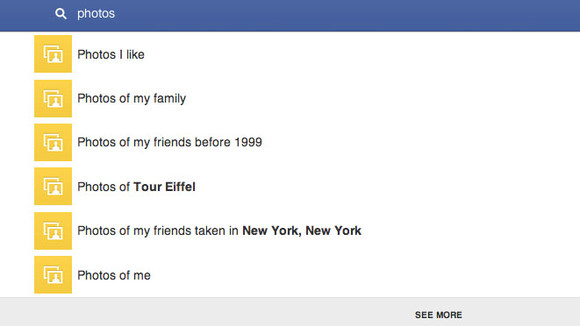
Graph Search appears as a bigger search bar at
the top of each page. As you start to type, suggestions appear in a drop
down. You can refine your search using the tools on the right-hand side
of the page.
"When you search for something, that search not only
determines the set of results you get, but also serves as a title for
the page," says Facebook director of engineering Lars Rasmussen. "You
can edit the title – and in doing so create your own custom view of the
content you and your friends have shared on Facebook."
What can you ask Graph Search?
Your Graph Search query can be
very specific. One example given at Facebook's launch event was "people
named Chris who are friends of Lars and went to Stanford" – so you
really can find someone you met once and remember by mere association.
You can also use a search example like "my friends who like Lady Gaga" or "photos of Sue taken in Bristol in 2005."
Why has Facebook launched Graph Search?
Facebook says there
are more than a billion people on the social network who have posted 240
billion photos and have more than a trillion connections. The company
believes it needs to provide "the tools to map out their relationships
with the people and things they care about." Facebook refers to this map
as "the graph."
"When Facebook first launched, the main way most
people used the site was to browse around, learn about people and make
new connections," says Rasmussen. "Graph Search takes us back to our
roots and allows people to use the graph to make new connections."
Is Graph Search taking on Google?
Graph Search and web
search are very different, explains Rasmussen. "Web search is designed
to take a set of keywords (for example: 'hip hop') and provide the best
possible results that match those keywords.
"With Graph Search
you combine phrases (for example: "my friends in New York who like
Jay-Z") to get that set of people, places, photos or other content
that's been shared on Facebook. We believe they have very different
uses."
What about Graph Search privacy?
Facebook says that
Graph Search has been built with privacy in mind, primarily because
often it's searching content that's very appropriate to you, but its
completely different from something that somebody else would see if they
did the same search.
According to Facebook, the Graph Search
"respects the privacy and audience of each piece of content on
Facebook," meaning you'll only see results you could already see
elsewhere on Facebook.
What's next for Graph Search?
The
social network says they're "very early" in the development of Graph
Search. It's only available in the U.S. today, and you can search for
only a subset of content on Facebook – people, photos, places and
interests only at the moment. Posts and some auto-generated content –
such as song plays from Spotify – can't yet be searched.
What are some example Graph Searches?
People:
"friends who live in my city"; "people from my hometown who like
hiking"; "friends of friends who have been to Yosemite National Park";
"software engineers who live in San Francisco and like skiing"; "people
who like things I like"; "people who like tennis and live nearby"
Photos:
"photos I like"; "photos of my family"; "photos of my friends before
1999"; "photos of my friends taken in New York"; "photos of the Eiffel
Tower"
Places: "restaurants in San Francisco"; "cities visited by
my family"; "Indian restaurants liked by my friends from India";
"tourist attractions in Italy visited by my friends"; "restaurants in
New York liked by chefs"; "countries my friends have visited"
Interests:
"music my friends like"; "movies liked by people who like movies I
like"; "languages my friends speak"; "strategy games played by friends
of my friends"; "movies liked by people who are film directors"; "books
read by CEOs"
 T he desktop on your Linux box used to stand for something very simple. If you were a KDE user, you valued control, power and the ability ...
 E ver since Nikon put a 24-million effective pixel sensor in the D3200 we've been expecting this pixel count to reach a little furth...
 J ust how bad do you have to be to get banned from Gmail? How many policies and terms do you have to violate to warrant suspension, or wor...
 W indows 8 users running Skype will now have the option to exert greater control over who can contact them, thanks to a new software updat...
 M cAfee AntiVirus (AV) Plus 2013 is a sub-$50 home security suite featuring a redesigned user interface (UI), along with extra security too...