Just how much money are you willing to be paid
to stop using Facebook altogether? Well, Paul Baier’s daughter was
offered $200 (to be paid out in stages) to quit Facebook, and
surprisingly, she said “Okay” to that deal, and will receive $50 this
coming April, with the remaining $150 on June 26th. Why June 26th? Well,
that particular date would mean the end of the school year, which
translates to an entire five months of life without Facebook.
Just before you wonder whether Paul is being too harsh on his
daughter, it was actually her idea to quit Facebook. Paul said, “She
turns it on, she’ll have 30 to 40 — 50 little alerts things popping up
too. She’s frustrated she can’t find babysitting jobs and she said,
‘Dad, would you pay me to get off Facebook?’ I thought she was joking.”
I guess this is where the wheat is separate from the chaff,
considering how she’s an honors student. I’m also quite sure that there
are other honors students out there who can still maintain a balance
between Facebook and life, but to each his or her own, eh?
Via
: www1.whdh
One woman in search of her biological parents found her apparent birth mother and father after posting a picture of herself on Facebook. On Jan. 27, Jenessa Simons shared a photo of herself holding a handwritten sign with her birth information.
Two days later, her birth mother reached out to her.
Simons' search began when she was 18, but she had to wait three years before submitting paperwork to the state. She decided to try her luck on Facebook while waiting, after seeing the success of posters who garnered 1 million likes for a puppy.
Her
photo included what little information she knew: her birthday, hospital, parents' dates of birth and contact information. They were 16 at the time, and they named her Whitney. The image spread quickly, with more than 14,000 likes and 160,763 shares at time of writing.
On Tuesday, Simons announced on Facebook that she found her birth mother and, later, contact information for her birth father. A high school friend of the two contacted Simons' biological mother, who got in touch with the 21-year-old.
She was skeptical at first,
reports an ABC affiliate, until the woman sent her baby pictures Simons' adoptive mother had given her.
There are numerous pages on Facebook geared toward those searching for their birth parents, and Simons hopes others will use the social network to reconnect with loved ones. In her post on Wednesday, she thanked those who shared her photo and story
Facebook’s photo tag suggestions was temporarily suspended last year in order to allow for “technical improvements,” but it seems after one year of tweaking, the feature is now ready for prime time again as the company announced the feature has been re-enabled in a post published yesterday.
Tag Suggestions will once again allow users to “easily identify a friend in a photo and share that content with them,” although we’re sure there are some photos they absolutely would not want on their profile, no matter how hot you think you look in the picture.
The feature was originally introduced in late 2010 and available one year later, but received backlash from U.S. and European users for privacy reasons, even though the feature was introduced as a way to help streamline the photo tagging process.
The re-enabled feature is currently available for only U.S. Facebook users as it looks as though Tag Suggestions has yet to be enabled in Europe.
If you wish to opt-out of the re-enabled feature, you can do so by accessing your Facebook account’s Account Settings, Timeline and then Tagging. Once there, to opt-out, you’ll need to edit the “Who sees tag suggestions when photos that look like you are uploaded?” option.
With almost twice as many smartphones shipping in Q4 of 2012 than the previous year, it’s no surprise that Google’s Android OS has maintained its lead in the smartphone race. A new report from Strategy Analytics estimates that a total of 152.1 million smartphones operating on Android shipped in Q4 of 2012, making Android’s global market share 70%, up from 51%, in Q4 of 2011.
With its open source ethos, Google’s Android OS has helped proliferate the manufacture and development of a variety of devices. Android devices of all colors and stripes have been popping up since it’s inception, ranging from high-end smartphones and tablets to entry-level devices. Unlike Apple, whose iOS only operates on a few devices produced strictly by Apple, Google lets manufacturers use the Android source code and customize it to their liking. It also allows Android devices to be sold at various price points, unlike the (new) iPhone that remains at a premium price.
It’s true that Android is dominating the smartphone market right now, but can it keep up with competing and emerging smartphone OS’s such as RIM’s new BlackBerry 10 OS and Firefox OS? Let us know what you think.
(Via: TechCrunch,Phandroid)
Over the last week, several Instagram users began reporting that the photo-sharing app was locking them out of their accounts, and asking them to confirm their identity by showing photo ID
These incidents, which
CNET first covered Tuesday, were reportedly a result of Instagram's new terms of service, which came into effect on Jan. 19.
At first, users were worried that their accounts were hacked. But
Talking Points Memo confirmed Friday that the ID requests were actually legitimate, and came from Instagram and Facebook, which now owns the photo-sharing app.
"This is just a general practice for both Facebook and Instagram to request photo IDs for verification purposes depending on what type of violation may have occurred," a Facebook spokesperson told Talking Points Memo. "Unfortunately, I can’t share more with you beyond that as we don’t go into details beyond that."
Identification is requested in cases when the social networks suspect that their terms of services have been violated. It aims to confirm who's behind an account, and perhaps to determine whether a user is underage (the minimum age to use both services is 13).

As Instagram doesn't require users to provide their real names, it's unclear why the photo-sharing app would ask for official ID. Facebook, on the other hand, does ask for users' real names. The social-network giant declined to comment on the matter.
Instagram's terms of service give the company the right to "refuse access to the Service to anyone for any reason at any time."
HTC has launched a new low-end, budget-friendly smartphone in China and Taiwan: the HTC Desire U.
The
device has a 4-inch, 800x480 pixel screen, a single-core 1GHz CPU, 512MB of RAM, 4GB of memory storage (further expandable via microSD memory cards) and a 5-megapixel camera. It also comes with Beats Audio.
It supports Wi-Fi, 3G and Bluetooth 4.0, and is powered by Android 4.0. It's currently scheduled to arrive only in China and Taiwan, but the exact date of availability hasn't yet been revealed. We don't know if an international version is in the works, but we might get a glimpse of the device (hopefully along with some other new models) at the upcoming Mobile World Congress, held 25-28 February in Barcelona.
 F
or all the reasons that Facebook is a massive success, it has one card that trumps the likes of Twitter, Google and LinkedIn: it knows who your real-life friends are. Kindly, Facebook shares that data with third parties apps using its Social Graph API—but it seems that privilege might not be a given for much longer.
TechCrunch reported last week that Facebook is cutting off access to the API for "competing" apps that don't share much back with the Big Blue. It started with Voxer—don't worry, nobody else has heard of it—but was, the 'Crunch claimed, planning to extend the policy further.
Now,
the Verge is reporting that Facebook seems to be refusing to authorize user requests to find friends on Vine. Doing so seems to throw up a message "Vine is not authorized to make this Facebook request", which suggests that the app doesn't have access to the Social Graph API.
If that's the case, it's obviously a massive bummer for Vine, which has been having problems straight outta the gate. And it does seem it could be the case: despite the fact that Vine is geared up for sharing with Facebook, it's run by Twitter which is— as we all know—a big Facebook competitor.
So, while we can't be certain that Facebook is locking down Social Graph, scraps of evidence are starting to point towards it. If it is the case, it will be interesting to see how Zuckerberg pushes forward with the policy: too much clamping down would leave Facebook as a walled garden; too little might give its competitors an edge it would rather not offer up. The ball is in Facebook's court.
[TechCrunch and Verge]
Of all Facebook’s data sets, it’s the social graph that’s truly unique. It’s spent nine years getting you to confirm who you know, and apparently it’s sick of handing over your friend list to competitors. This week it cut off both Twitter’s new photo app Vine and messaging app Voxer from Find Friends, Facebook’s API that lets you connect with Facebook friends on other apps. But this could backfire.
Facebook knows who you are, what you’re interested in, where you go on the web, what apps you use, and more. However, other companies have bits and pieces of these data sets. LinkedIn knows your resume, Google knows your web searches, Twitter knows who you follow, Apple and Amazon have your credit card number, and your phone’s OS-maker knows what apps you’ve downloaded. Who your real-life friends are, though, is Facebook’s domain.
Facebook Social Graph
Reconfirming your social graph manually on other apps is awkward at worst and annoying at best. Think about it. If your Facebook account was reset and you had to send friend requests to all your old friends, how many do you think would confirm? Even your best friends might be too lazy to, and people who were glad to friend you when you met years ago probably wouldn’t bother if they remember you.
There’s plenty of noise in the Facebook’s social graph. Some people blindly accept most requests they get, others send them to anyone they meet once, and all the connections grow stale over the years. Still, if you want to jumpstart a social app, Facebook’s Find Friends feature is very valuable. It can be the difference between an empty feed and low retention, and a vibrant, addictive feed teeming with content from people you care about.
Find Friends ScreenshotFacebook has offered Find Friends for years. But those were years when it was a web-based social network. It’s more now, or at least it wants to be. Facebook hopes to host all the ways you communicate. That has pitted it against Apple, Google, and other companies in war for messaging that’s only just heating up.
Data portability first became a big issue in 2010 when Facebook blocked Twitter from using its Find Friends feature. Later that year it got into a spat with Google about exporting contact lists. Google was pissed Facebook was sucking in Gmail contacts but not exporting friend lists. Facebook eventually began offering Download Your Data, which included your Friend List, but only in plain text.
More recently though, Twitter may have awoken the dragon when it cut off Instagram’s access to Twitter’s own version of “Find Friends”. It was an understandable retaliation since Facebook had cut it off, and Twitter had wanted to buy Instagram too.
Now Facebook is coming out swinging, citing its
Platform Policy that states “Competing social networks: (a) You may not use Facebook Platform to export user data into a competing social network without our permission.”

Last week it blocked voice messaging app Voxer’s access to the social graph. At the time, Facebook told me this was because Voxer qualified as a competing messaging, but also because Voxer wasn’t contributing much back to Facebook. Voxer only had a buried, and largely unnecessary ”share to Facebook” option. It got an email stating its Find Friends access would be revoked 48 hours later.
Then today Facebook shut off Find Friends for Twitter’s Vine, as spotted by Jeff Martines and reported by The Verge. That makes both more and less sense. More because Twitter is a real competitor. It has decent scale and mindshare, and competes for the same advertisers as Facebook. Twitter would love to know your Facebook social graph, which could help it refine its version, the “interest graph”, which powers its ad targeting.Vine Blocked.
It makes less sense because Vine had a prominent “share to Facebook” option. What happened to Facebook only going after apps that don’t contribute much back? Apparently that got overruled because Twitter is a more legitimate threat. So much so that Facebook employed its policy that “we reserve the right to take action against your app even before the end of this 48 hour period.” It didn’t want Twitter getting any social graph data.
Enforcement of these policies could create a moat around Facebook. It creates a barrier to engagement, retention, and growth for competing companies. It will force social apps to rely on other data sets, such as your phone’s contacts which may not have as complete of a social graph, though likely does include your closest friends whose numbers you have.
That advantage may not be worth it, though. The enforcement means Facebook is not an “open platform”. If companies are worried that Find Friends or other Facebook data access could be ripped away from them with little notice, it could cause a chilling effect on development on the Facebook platform. No one wants to build an app that relies on Facebook data if it could disappear.
Facebook reaffirmed this fear this morning when it enforced its ban on exporting data for use in social networks. Russian search engine Yandex’s new social search mobile app Wonder got all of its API calls blocked just three hours after launch. That’s a lot of programming and product work down the drain.
Facebook is playing with fire. It could use policy enforcement to cook competitors and shine a light on its dominance of social networking. But if this enforcement scares off developers whose apps might otherwise provide content for that could be shown next to ads in the news feed and piped into Graph Search, Facebook could get burned badly.
Via techcrunch (Thanks)
Twitter rolled out its video-sharing app called Vine on Thursday morning, and by Thursday evening it already looks like your Facebook sharing options are limited. Perhaps we’ve moved from photo wars to video wars? It looks like users are no longer able to connect with friends on the “find friends” page of Vine through their Facebook social graph, even though a Facebook sign-in is one of several options to find new users on Twitter’s video-sharing network.
Twitter Vine video Facebook login Twitter declined to comment on the development, and Facebook hasn’t yet responded to our request for comment. But the competition is hardly surprising as the two companies compete for user attention. After all, the social graph is one of the most valuable products Facebook holds. But it’s a bummer if you’re looking for a nice video experience on Vine right off the bat.)
So far, you can still share videos out to Facebook, but with the relationship between Facebook’s Instagram and Twitter having recently deteriorated, a rocky Facebook/Vine relationship wouldn’t be surprising.
Twitter initially blocked Instagram users from finding friends through the micro-blogging service back in July. Instagram then removed support for Twitter cards in December, meaning users would have to head to Instagram to see their friends photos. And then Twitter rolled out its photo-editing features in direct competition with Instagram.
When Twitter is too short and Facebook has too many judgmental
friends from high school, there’s Tumblr to share your deepest thoughts
and most hilarious GIFs. Now the social blogging platform is
streamlining the way you post photos of your cats.
Tumblr started
rolling out an inline composition feature in the Dashboard to users on
Thursday. Now when you add a new post to your feed, instead of being
pushed to a new page away from all the awesome posts of your Tumblr
friends, you can post directly in the Dashboard view.
One of the cooler features is the ability to drag and drop photos
directly into a post and drag that photo into any arraignment in said
post.
Tumblr told Wired via email that the new feature will be rolling out
to all users over the next couple days. So by next week you’ll be able
to quickly post your
Fringe fan fiction in a manner that resembles Facebook and Twitter posts.
Via The Verge (Thanks)
We're seeing numerous reports that Facebook has begun enabling Graph Search for users that were among the first to sign up for the beta program last week. The ambitious new feature promises to change the way you find things on the social network by returning results to natural language queries like "restaurants nearby my friends like" and "pictures of my friends and me." Once you accept Facebook's invitation to try Graph Search, the menubar at the top of the site will switch to a new design that places universal search on the left and relocates friend requests, messages, and notifications over to the ride side of the screen. If you're lucky enough to be among the early participants, feel free to discuss your thoughts on the new Facebook below. And for those that haven't gotten around to it yet, it's not too late to join the
Graph Search waiting list.
 Facebook is the most popular mobile app in the U.S. in terms of unique users — at least for now.
The signature Facebook app passed Google Maps in October of last year to become the most used mobile app in the U.S. and held onto the top spot through the end of the year, according to data released Wednesday by comScore Mobile Metrix.
Facebook's app enjoyed strong growth in 2012 with 85.5 million monthly unique users in the U.S. in December across iOS, Android and RIM's mobile platforms, up from just under 65 million in March, when comScore first started tracking mobile app data. (In October, Facebook reported 604 million monthly mobile users worldwide.) Google Maps, on the other hand, saw its active user numbers dip from about 80 million in August and September to a little more than 70 million in October after it was removed as a default app on iOS 6.
"Both Google Maps and Facebook were growing nicely throughout the year until that happened," Andrew Lipsman, VP of industry analysis at comScore, told Mashable. "Facebook continued that trend and Google Maps took a dip that one month and now it's climbing back." Google launched a new Maps app for iOS 6 in mid-December, and Lipsman says it's likely Maps will grow its user numbers at a faster rate going forward, though it's unclear whether and when the app will return to the top spot.
ComScore's mobile app data is based on browsing behavior tracks from a panel of users as well as supplemental data from publishers showing app usage. The numbers represent active visitors to apps — rather than app downloads — similar to the way that comScore tracks visitors to websites.
While Facebook currently held the top spot at the end of the year, Google had the next five most used apps, including Google Maps, Gmail and YouTube. Lipsman credited this to the growth of Android and the popularity of Google services in general.
Aside from having the largest audience, Facebook's app also has by far the highest level of engagement. According to comScore, Facebook's app accounted for 23% of time spent on mobile apps while all of Google's apps collectively account for 10% of time spent.
Facebook has admitted that it has 'no effective mechanism in place' to prevent children under the age of 13 from setting up profiles.
The social network decrees that users have to be at least 13 to join the site, but the lack of an effective age verification system makes it easy for pre-teens to sign up for an account.
Despite Facebook's efforts, research from a professor at the London School of Economics estimates that a massive 34 per cent of UK 9-12 year olds now have a Facebook page.
Facebook's director of policy for Facebook UK and Ireland, Simon Milner called the problem "tricky" but admitted there is no system in place to prevent young children lying about their age.
Facebook isn't unsafe?
Speaking at an Oxford Media Convention, he said: "We haven't got a mechanism for eradicating the problem."
Surprisingly, Milner also hinted that if not for a US privacy law, the age restrictions may not be in place, because the company does not feel that Facebook is unsafe for young children.
He added: "Facebook does have a rule that users have to be over 13, as does YouTube, which not a lot of people know.
"It is not because we think that Facebook is unsafe but because of a US law about children's online privacy. So we have it as a global rule."
Young kids listen, teens don't
Sonia Livingstone, the LSoE professor who conducted the research, reckons the number of underage users is only going to get higher as social media continues to flourish.
She said: "I would assume that figure is going up and would assume younger children are also having profiles.
"If parents would only say to young children, 'don't go on Facebook', we have found that they listen. Teenagers don't, but younger children do."
Despite claiming that Facebook isn't unsafe for pre-teen users (and those above 13 for that matter), Milner insisted that it has tough policies to eliminate bullying, grooming, pornography and nudity.
Via Guardian (Thanks)
Last month, social media expert Mari Smith found out that Facebook was testing a redesign to a proposed one-column timeline layout. According to sister site Inside Facebook, it appears that another design is being tested, as well — one that places open graph activity on the left and posts on the right.
Tipster
Matt Navarra sent in this screenshot to Inside Facebook, showing activity and friends sampling on the left, with posts on the right:
It’s important to note that this is simply a test and does not mean that this will be implemented anytime soon on a permanent basis.
Open graph activity — such as songs listened to or achievements in games played — is off to the left, and posts made by the user and his or her friends are on the right — a switch from the previous design shown by Smith and ABC News.
Inside Facebook’s Brittany Darwell noted that when a user wants to highlight a post on their page, it gets a blue banner instead of being made bigger and spread across the layout.
This single-column timeline addresses one of the main complaints about the current format, which moves posts around as it loads.
Readers: What do you think about this latest tested design?
It’s been a long time coming, but the dawn of a new RIM age is finally upon us: the Canadian company is launching its next-generation BlackBerry 10 platform and accompanying handsets on 30 January. (Though, with all the delays we’ve endured, you couldn’t fault us for refusing to believe it until we see it.) As we hold our breath for the impending unveiling, we’re digging deep into just what the OS will mean for RIM in particular and for the mobile market in general.
Accordingly, this is Technewswesite’s ongoing home for all BlackBerry 10-related content, to be updated as more details inevitably surface over the coming days. We’ll be stocking the page with relevant news, commentary and reviews as they emerge, so stay tuned for the latest RIM and BB10 reports.
23 January 2013
Things are beginning to look up for RIM, with chief executive Thorsten Heins’ public comments about the company’s strategic options moving forward having seemingly boosted the market’s confidence in the Waterloo, Ontario-based firm. Speaking to German newspaper Die Welt, Heins said RIM is mulling over its options, which include possibly selling off its hardware division or, as has been alluded to in the past, licensing out its software to other manufacturers. While Heins insisted that the priority for now is ensuring the successful launch of BlackBerry 10 next week, that didn’t stop the market from registering its approval - in New York, shares of RIM shot up 17 per cent after Heins’ comments, while the stock jumped 11 per cent in Toronto.
22 January 2013
We’ve exhausted many brain cells wondering what changes RIM will introduce with its BlackBerry 10 software, but let’s not forget the launch of the next-gen platform will also mean next-gen smartphones. Previous speculation suggested that the company will launch a handset with a physical keyboard - one of BlackBerry’s biggest selling points to its remaining customer base - with a full-touchscreen device due to follow. But with just seven days to go before the official launch, new reports have revealed more about the rumoured BlackBerry Z10 handset. The rumour mill points to a low pricepoint - sub-$149 (£94) with a two-year contract - for what is expected to be the platform's flagship device.
21 January 2013
With less than a week to go before the launch of BlackBerry 10, RIM has announced a new change to its app store - the market place, formerly known as BlackBerry App World, will now be called BlackBerry World. The moniker shift purportedly represents BB10’s redesigned market place, which promises to offer media and entertainment content, like music and movies, in addition to apps. The change "reflects a shift in the type of things you can purchase from the store as we transition to Blackberry 10 and beyond," RIM said. The new BlackBerry World is now available for desktops and existing BlackBerry handsets and tablets, though we’re likely to hear more about it at next week’s launch.
15 January 2013
As the mobile operating system wars heat up, it’s become increasingly clear that apps hold much sway with the public. iOS and Android, both of which attract developers in droves, have an upper hand over Windows 8 and BlackBerry simply because of the sheer number, and quality, of apps available for their platforms. But as RIM prepares to introduce its next-generation BlackBerry 10 OS, few things will be as critical to its success as being able to brag about the number of apps it has on offer. And it looks like the Canadian firm just might be able to pull it off - RIM has revealed that it received 15,000 app submissions in less than two days following two Port-A-Thon events. We’ll have to wait and see how many of them make it into the store, but it’s certainly a promising start.
Well, Facebook didn't reveal a new phone or operating system today -
instead the social network announced a new Graph Search. This new
feature offers a multitude of new ways to use Facebook's search function
to help you find the right people, photos and more.
What is Graph Search?
You
can still search in the usual way, but you can also ask Graph Search to
find exactly what you're looking for. Launching now is the beta (or
early) version of Graph Search, and it focuses on four areas: people,
photos, places and interests. It's only available in U.S. English for
now.
What is Graph Search?
Graph Search is a new way for you to find people, photos, places and interests that are most relevant to you on Facebook.
You'll
be able to find others even though you may not know their name, as well
as learn more about them and make connections. What's more, you can
explore photos, quickly find places like local attractions and
restaurants, and learn about friends' common interests such as music,
movies and books.
Graph Search appears as a bigger search bar at
the top of each page. As you start to type, suggestions appear in a drop
down. You can refine your search using the tools on the right-hand side
of the page.
"When you search for something, that search not only
determines the set of results you get, but also serves as a title for
the page," says Facebook director of engineering Lars Rasmussen. "You
can edit the title – and in doing so create your own custom view of the
content you and your friends have shared on Facebook."
What can you ask Graph Search?
Your Graph Search query can be
very specific. One example given at Facebook's launch event was "people
named Chris who are friends of Lars and went to Stanford" – so you
really can find someone you met once and remember by mere association.
You can also use a search example like "my friends who like Lady Gaga" or "photos of Sue taken in Bristol in 2005."
Why has Facebook launched Graph Search?
Facebook says there
are more than a billion people on the social network who have posted 240
billion photos and have more than a trillion connections. The company
believes it needs to provide "the tools to map out their relationships
with the people and things they care about." Facebook refers to this map
as "the graph."
"When Facebook first launched, the main way most
people used the site was to browse around, learn about people and make
new connections," says Rasmussen. "Graph Search takes us back to our
roots and allows people to use the graph to make new connections."
Is Graph Search taking on Google?
Graph Search and web
search are very different, explains Rasmussen. "Web search is designed
to take a set of keywords (for example: 'hip hop') and provide the best
possible results that match those keywords.
"With Graph Search
you combine phrases (for example: "my friends in New York who like
Jay-Z") to get that set of people, places, photos or other content
that's been shared on Facebook. We believe they have very different
uses."
What about Graph Search privacy?
Facebook says that
Graph Search has been built with privacy in mind, primarily because
often it's searching content that's very appropriate to you, but its
completely different from something that somebody else would see if they
did the same search.
According to Facebook, the Graph Search
"respects the privacy and audience of each piece of content on
Facebook," meaning you'll only see results you could already see
elsewhere on Facebook.
What's next for Graph Search?
The
social network says they're "very early" in the development of Graph
Search. It's only available in the U.S. today, and you can search for
only a subset of content on Facebook – people, photos, places and
interests only at the moment. Posts and some auto-generated content –
such as song plays from Spotify – can't yet be searched.
What are some example Graph Searches?
People:
"friends who live in my city"; "people from my hometown who like
hiking"; "friends of friends who have been to Yosemite National Park";
"software engineers who live in San Francisco and like skiing"; "people
who like things I like"; "people who like tennis and live nearby"
Photos:
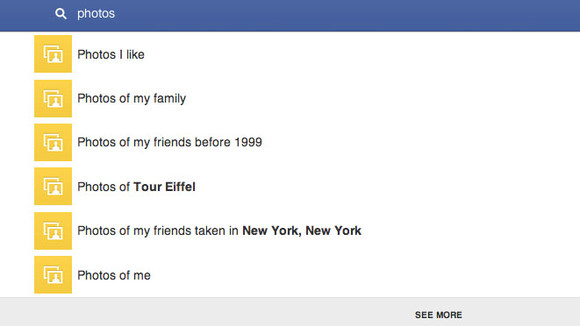
"photos I like"; "photos of my family"; "photos of my friends before
1999"; "photos of my friends taken in New York"; "photos of the Eiffel
Tower"
Places: "restaurants in San Francisco"; "cities visited by
my family"; "Indian restaurants liked by my friends from India";
"tourist attractions in Italy visited by my friends"; "restaurants in
New York liked by chefs"; "countries my friends have visited"
Interests:
"music my friends like"; "movies liked by people who like movies I
like"; "languages my friends speak"; "strategy games played by friends
of my friends"; "movies liked by people who are film directors"; "books
read by CEOs"
Facebook’s long-rumored phone ishere, though probably not in the way most had imagined. In fact, it looks exactly like the phone you already have.
Using software, rather than hardware, the latest update of Facebook’s Messenger app now lets U.S. users place voice calls over WiFi. The rollout follows reports of Facebook testing voice call features in Canada earlier this month.
To use the feature, Facebook users must hit the “i” info icon in the corner or a conversation or contact information page. That panel has a “Free Call” button that you can use if your friend has the latest version of the iPhone app.
The company slowly has been building out the features available in chat — most notably with the 2011 Skype partnership that put video calling on the Web version of its site. When it released Facebook Messenger last fall, it became even clearer that messaging and mobile applications were priorities for the company.
Rumors of a Facebook phone have been circulating for year, despite statements from Facebook, its chief executive Mark Zuckerberg and analysts saying that making a physical phone isn’t a good idea for the network.
It does make sense for Facebook to make it easy for users to contact their online networks. But the smartphone industry is not an easy one to crack. Apart from the fact that Facebook hasn’t made hardware in the past, the telecommunications world has lots of complicated barriers to entry such as dealing with carriers and the challenge of taking on Apple’s iOS and Google’s Android mobile operating systems. Facebook also could go the partnership route, but it’s already done that with the not-so-successful HTC Status.
Consumers are increasingly looking for companies and devices that give them a rich, complete experience rather than those that do a single thing. Take, for instance, the iPod, which has had to become a still and video camera in addition to playing music to hang on in a post-iPhone era.
By going the software route, Facebook can step neatly around those issues. And it’s not alone, as was clear from the growing software and content focus at this year’s International Consumer Electronics Show. Much of the tech industry is using this same approach — software, not hardware — to test the appeal of features without getting entrenched in building, marketing and drawing users to their gadgets..!

The tech press started buzzing earlier this month with reports that Facebook planned to add VoIP (voice over IP) calling to its Messenger app for the iPhone. The new feature officially arrived Tuesday, when Facebook released an update for its app.
Facebook's app transmits calls using your phone's broadband connection, whatever it is -- 3G, 4G or Wi-Fi. Instead of sucking up your monthly allotted voice minutes from your cellular carrier, it sucks up megabytes from your data plan. That's a boon for heavy talkers with unlimited data plans.
This is nothing new or technologically groundbreaking: Skype was doing it long before Facebook. Facebook has many more active users than Skype, though, and the allure of having to use one less network or app will appeal to some (perhaps many).
But it's not all roses just yet. For now, this is a pretty limited offering.
Your phone won't alert you the way it does when you have a normal call: Facebook calls just show up as a push notification. And right now, you can only connect with a conversation partner who also has Messenger installed on their iPhone.
There's no way to ring up a Facebook friend who is logged in through the website, and there isn't any way to place a call to a ten-digit phone number. Calling is still absent from the Android and BlackBerry versions of the Messenger app.
There's a good reason for those omissions. The VoIP features in the Web version of Facebook were built using Skype's technologies, while the calling technology in Messenger is all Facebook. The ability to place and receive calls using traditional phone numbers requires telecommunications resources Facebook doesn't have (at the moment, at least).
For the time being, services such as Google (GOOG, Fortune 500) Voice and Skype have a leg up, given their larger feature sets. But Facebook generally doesn't let anything remain in stasis for long. As we've seen in the past -- and caught a glimpse of yesterday with the Graph Search reveal -- Facebook likes to start small, and steadily flesh out its products. Expect the same with voice calling.
And unlike Google Voice and Skype (which is owned by Microsoft (MSFT, Fortune 500)), Facebook is 100% platform neutral. Facebook (FB) doesn't care if you use its app on an iPhone, Android, Windows Phone, BlackBerry or something crazy like Ubuntu.
In a time when every company is saving the best features of its products for its own mobile ecosystem, Facebook has the opportunity to both usurp its direct competition and build out a telecom-slaying voice service.
Facebook’s new Graph Search feature suddenly makes the search bar at the
top of its pages — which you were probably ignoring — a lot more
interesting.
The updated search function, announced Tuesday, lets users dig through most of the the Facebook data that’s visible to them on the site to answer some simple questions. The company is rolling the feature out slowly, so it’s in a limited beta at the moment. But here are some practical ways in which you can or will be able to use Facebook’s Social Graph:
Look for a bite to eat: The graph allows users to look for places, photos, interests and people. But beyond simply searching for area restaurants that your friends “like,” you can tailor your search to restaurants that have gotten a nod from friends who have also posted on Facebook that they lived in a certain country, like Thai food or are vegetarians.
Help with a career search: Your Facebook network may be bigger than you think, given how much gets shared with friends of friends, and Graph Search lets you sift through all of that data. So, if you’re looking for a job in a particular field or city, you could search for “friends of friends who are lawyers” to find some contacts. You could also look for a particular company name to find a contact there. But etiquette dictates that you ask your mutual friend for permission before sending his or her friend a Facebook message.
Find a date: Company chief executive Mark Zuckerberg highlighted this option in Tuesdays press conference, according to a report from VentureBeat. Since Facebook allows users to post whether they’re married, single, in a relationship or romantically “complicated” entanglements, you could run a query for “friends of friends who are single and like mountain biking.” Voilà -- instant date prospect. This could also prove to be an invaluable tool for busybody matchmakers.
Take a nostalgic look back: Heading down memory lane? Photo searches can reveal pictures of your alma mater within a certain time period. Or you can look for photos that folks have posted of themselves as kids by typing in a search for pictures taken before a certain year. As with other queries, you can stack terms in photo searches, so you could also look for photos of a certain place at a certain time. If you’re ready to go back to the future, you can also get ideas for where to go on your next trip by perusing other people’s vacation snaps.
Find a good read: You can look up books your friends like, or be more specific in your query: “books my friends who like War and Peace like.” You can also use this tool to find books that people in certain professions or areas of the country are reading.
Organize a pickup game: If you’re feeling restless, why not search for friends nearby who like the same sport you do — soccer, basketball, ultimate frisbee, whatever — and organize a quick pickup game. The same goes for users seeking running buddies, biking companions or — why not? — chess partners or fans of the same co-op video game.
Finally, if some of these applications seem a little invasive, you can take measures to limit what data of yours go into social graph search. That could involve spending quite a bit of quality time with the network’s privacy tools.
All the things mentioned above are examples of data that you may be sharing with friends of friends or the public. On Facebook, every post comes with its own privacy drop-down menu, so you can adjust your posts and likes whenever you want to restrict it to certain friends or groups. Only those friends will see that information pop up in any of their own searches.
Facebook users can change settings on their bio and geographical information by editing their “About” section. There’s also has a new drop-down menu at the top of most pages that lets you set future default privacy settings for future posts.!
Facebook’s 1 billion users will soon be able to search their friends’ favorite vacation spots or most-traveled running trails using a new tool unveiled by the company Tuesday.
Graph Search marks Facebook’s entry into the search market currently dominated by Google and could allow the social network to leverage the treasure trove of information it keeps on the “likes,” interests and preferences of its users with advertisers.
“Graph Search lets you tap into the value of that information,” said Kate O’Neill, a Facebook product marketing manager.
Facebook said that users will be able to look up such information as “friends who live in my city,” “photos I like” or “Indian restaurants liked by my friends in India” and get the results instantly. Microsoft, which holds a small stake in Facebook, will serve up answers from the Bing search engine when Facebook can’t.
“The social link gives you additional context,” said Andrew Tonner, an analyst with the Motley Fool. “You’re more likely to take some sort of action if someone you know has also had a favorable experience.”
Facebook chief executive Mark Zuckerberg announced the effort with much fanfare at the company’s California headquarters. Investors have been nervous about Facebook’s ability to sustain revenue since its public offering last year and appeared unimpressed by the company’s announcement. Facebook shares, which soared ahead of the announcement, fell nearly 3 percent on the news, closing at $30.10 per share.
The test version will not come with enhanced advertising and is not available on mobile devices, which make up an growing share of Facebook’s traffic.
If the tool is successful, Facebook could become competitive with Google, which has more than 60 percent of the search market and has made a similar attempt to marry search and social data. Although the two companies have similar products, said Ovum technology analyst Jan Dawson, they’re currently serving different audiences.
“Facebook is never going to answer your homework questions,” he said.
Making the network’s data easier to search could raise privacy concerns. Facebook noted that search results will display only data already visible to a particular user.
That mitigates some of the concerns, as does Facebook’s recent push to have users review privacy settings on their older posts, said Justin Brookman, director of consumer privacy at the Center for Democracy and Technology.
The fact that users will have to seek out the information rather than having it automatically displayed also makes a big difference, he said. “It’s not a push — it’s a pull,” he said.
 T he desktop on your Linux box used to stand for something very simple. If you were a KDE user, you valued control, power and the ability ...
 E ver since Nikon put a 24-million effective pixel sensor in the D3200 we've been expecting this pixel count to reach a little furth...
 J ust how bad do you have to be to get banned from Gmail? How many policies and terms do you have to violate to warrant suspension, or wor...
 W indows 8 users running Skype will now have the option to exert greater control over who can contact them, thanks to a new software updat...
 M cAfee AntiVirus (AV) Plus 2013 is a sub-$50 home security suite featuring a redesigned user interface (UI), along with extra security too...